
Here are three big questions ahead of Tuesday's NBA Cup championship.
We can dispense with the bells and whistles now: the inflated point differentials and arcane tiebreakers, the only-on-special-occasions scheduling and intermittently unsafe or unavailable alternate playing surfaces, etc. What’s left at the 2025 Emirates NBA Cup is all that’s ever left when the game matters most: two teams, with only one game and one another standing between them and a big ol’ trophy.
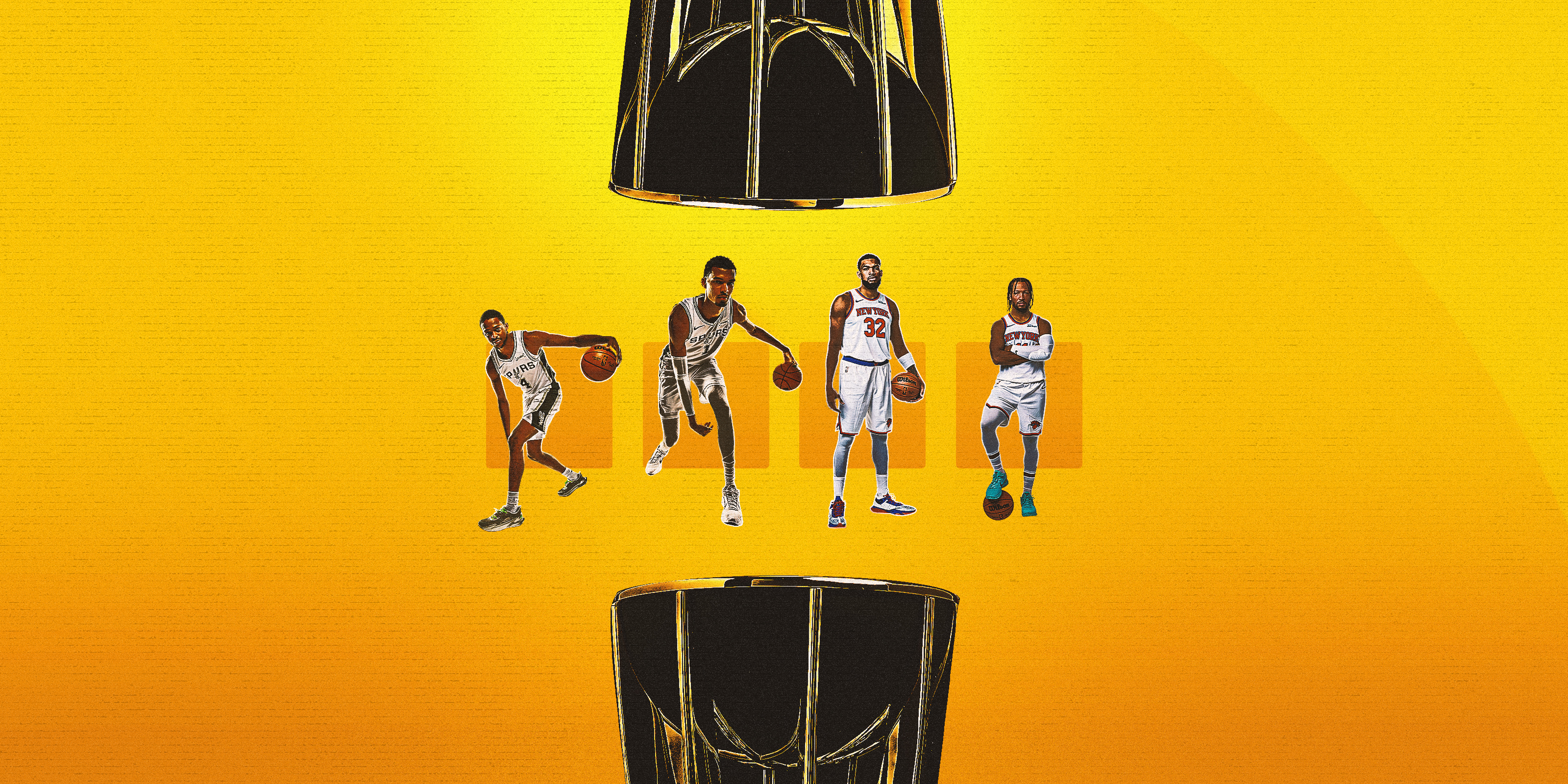
What began as a league-wide effort to inject some flavor into the period between opening night and Christmas Day concludes with two teams vying for 35 pounds of sterling silver topped with 24-karat gold. Out of the West: the San Antonio Spurs, who shook off an early double-digit deficit to the Oklahoma City Thunder — the defending NBA champions and a mid-coronation juggernaut that was riding a 16-game winning streak and a 24-1 start to the season — with the kind of confidence that can only come from knowing that you have a Hulk:
Victor Wembanyama played 21 minutes in his first NBA action in nearly a month; San Antonio outscored Oklahoma City by 22 points in those 21 minutes. (Welcome back, big fella.) With the transformational center joining De’Aaron Fox, Stephon Castle and Devin Vassell in a quartet of 20-plus-point scorers, the Spurs came back from 16 down to hand the Thunder just their second loss of the season, pulling off the upset — although not a gigantic one, considering they’re 18-7 and all — to punch their ticket to the championship game.
Joining them in the Cup final: the New York Knicks, who advanced out of the East by knocking off the Orlando Magic for the second time in a week behind a masterful performance from their captain:
Jalen Brunson’s 19th 40-point game as a Knick — third-most in franchise history, behind only Patrick Ewing and Bernard King — paced yet another high-octane outing for the NBA’s No. 2 offense. With Brunson dealing, Karl-Anthony Towns torching Orlando’s bigs to the tune of 29 points on 11 shots, and the wing trio of OG Anunoby, Mikal Bridges and Josh Hart continuing their sterling starts to the season, the Knicks shot 60.7% from the field against an elite Magic defense in a 132-120 victory — their fifth straight and ninth in the last 10 games — to reach the winner-take-all finale.
Let’s set the table for what’s sure to be a thrilling conclusion by considering three big questions ahead of Tuesday’s NBA Cup championship (8:30 p.m. ET, Prime Video):
1. How will New York deal with Wemby?
The last time the Knicks saw Wembanyama — in the Christmas Day matinee nearly one year ago — things didn’t really go so hot.
Wembanyama set foot on the floor at the World’s Most Famous Arena and announced his presence with jaw-dropping authority: 42 points on 31 shots, 18 rebounds, 4 assists, 4 blocks and 1 steal. He and then-Spurs point guard Chris Paul repeatedly attacked Towns in the pick-and-roll, with Wembanyama either popping free for open 3-point looks or working his way behind Towns’ drop coverage for point-blank opportunities against the Knicks’ rotating low-man defenders — who were often a foot or more shorter than the French phenom.
New York still came away with the win, thanks partly to a season-high 41 points from Mikal Bridges — and, partly, to seizing the opportunity to make hay while the sun was out, which is to say, when it was not being blotted out by a devastatingly coordinated skyscraping Slenderman. The Spurs outscored the Knicks by seven points in Wembanyama’s 40 minutes of floor time last Christmas; in the eight minutes the big fella took a seat, New York outscored San Antonio 21-11.
You’d imagine Wembanyama won’t approach 40 minutes in his second game back from a prolonged absence due to a calf strain. (You’d also imagine a Spurs team now featuring Fox, an improved version of second-year guard Castle, impressive freshman Dylan Harper and a bona fide backup center in ex-Knick Luke Kornet might not be quite as susceptible in the non-Wemby minutes … although it’s worth noting the Thunder blitzed San Antonio by 19 points in the 27 minutes that Wemby was on the pine.) But it’ll be interesting to see how he’s deployed in whatever minutes he does get — particularly on the defensive end.
Wembanyama primarily guarded Towns and then-Knicks backup center Precious Achiuwa in that Christmas matchup. As the season wore on, more and more teams started cross-matching against New York, putting a wing on Towns to better switch the KAT-Brunson pick-and-roll while stationing their centers on Hart, allowing their bigs to sag off a player known to be an inconsistent shooter to better protect the basket and muck things up on the interior.
That gambit was very successful last season, and the starting lineup of Brunson, Towns, Hart, Bridges and Anunoby waned in effectiveness as a result. This season, though, with Hart shooting 38.1% from 3-point range, that quintet has been dynamite, outscoring opponents by 37 points in 77 minutes, with a net rating of +21.5 — the sixth-best mark of any lineup to log at least 50 minutes this season, according to NBA Advanced Stats.
Will Spurs head coach Mitch Johnson test-drive a cross-match — say, Harrison Barnes (and/or Justin Champagnie, Jeremy Sochan and Keldon Johnson) on Towns and Wembanyama (and/or Kornet) helping off Hart — and make the Knicks prove they can problem-solve their way around a defense with elite rim protectors hanging around the rim? Or might San Antonio just decide to play things straight up and challenge New York to generate consistent buckets against a defense that has prevented points at a top-two level with Wemby on the floor?
The matchup’s pretty spicy on the other end, too. On one hand, the notion of Towns taking on the bulk of the Wembanyama assignment seems like a five-alarm fire for the Knicks, considering Wemby has averaged nearly 32 points per 75 possessions when guarded by Towns since his rookie season, according to Databallr’s matchup data. On the other, Wemby went 7-for-16 in the Christmas contest when matched up with Towns, who has quietly been playing perhaps the best defense of his career this season. Will Mike Brown trust KAT to hold up, perhaps with Anunoby shading over as a helper to provide some extra muscle, disruption and secondary rim protection? Or might Brown — who, lest we forget, was not the Knicks’ head coach when these two teams last squared off — try to throw a curveball to keep the Spurs’ ascendant superstar from wrecking the game?
2. Can San Antonio’s guards collapse New York’s defense?
Before the Spurs’ quarterfinal matchup with the Lakers, while the smart money seemed to be on Luka Dončić, LeBron James and Co. to advance, some extremely attractive and incredibly humble local hero suggested that L.A.’s point-of-attack defense might be ripe for the plucking by San Antonio’s perimeter talent:
¯\_(ツ)_/¯ https://t.co/YKxwOVRdlC
— Dan Devine (@YourManDevine) December 11, 2025
Sure enough: San Antonio finished that game with 53 drives to the basket — 37 of which came from the trio of Castle (who exploded for 30 points, 10 rebounds and 6 assists), Fox and Harper — and went 23 for 39 in the paint, earning 36 trips to the free-throw line and generating 13 catch-and-shoot 3-pointers in an impressive, dominant road win.
The overall volume of marches to the cup was bound to decrease against the league-leading Thunder defense. Even still: Castle, Fox and Harper combined for 35 drives to the basket against Oklahoma City, and while the Spurs struggled to cash out on them, those forays into the teeth of the OKC coverage did generate a bunch of good looks:
While Wembanyama was healing up, the Spurs shifted into an offense-first attack — 119.7 points per 100 non-garbage-time possessions since Nov. 15, according to Cleaning the Glass, ninth-best in the NBA in that span — with the dribble penetration, rim pressure and facilitation of Fox, Castle and Harper at the forefront of that acceleration. All three of those ball-handlers are big, quick, physical and adept at both slithering through cracks in coverage to get all the way to the rim and creating (and often finishing through) contact in the process. And when they’re able to collapse the defense and spray the ball out to waiting shooters like Barnes, Champagnie, Johnson, Vassell and one another, the offense can hit the sort of high notes that would allow San Antonio to trade haymakers with a Brunson-and-KAT-led attack that’s been the NBA’s most potent outside of Denver this season.
The premise behind the Knicks’ roster construction over the past couple of years is that adding Anunoby, Bridges and Hart — big, physical, versatile and excellent perimeter defenders — would insulate the more vulnerable Brunson and Towns, and allow New York to play high-level defense against high-level perimeter playmakers in games of consequence. The theory bore fruit against the heavily favored Celtics in the 2025 Eastern Conference semifinals; it wobbled, however, in the subsequent round against the Pacers, contributing to New York failing to break through to the NBA Finals for the first time in 25 years. Through this season’s first 25 games, the Knicks have defended at an elite level with that five-man unit on the floor. Those numbers have been propped up, however, by opponents shooting just 30.6% from 3-point land against it, a league-worst-caliber — and all but certainly unsustainable — rate of long-range inaccuracy.
If Anunoby, Bridges, Hart and Co. are able to stand tall at the point of attack, corralling the Spurs’ ball-handlers off the bounce and keeping Castle, Fox and Harper from collapsing the coverage, San Antonio could struggle to consistently create good enough scoring chances to keep pace with a Knicks attack that’s been humming all season. If they can’t, and if the Spurs’ perimeter quickness, strength and athleticism once again shines through — the absences of Deuce McBride and Landry Shamet, New York’s two best perimeter defenders off the bench, could loom large, especially when Brown has to turn to the, um, huntable Tyler Kolek and Jordan Clarkson — New York could be in for a long, tough night in Sin City.
One more note:
Under Tom Thibodeau, the Knicks barely ever played zone defense. Under Brown, they’re dialing it up 2.3 times per game, according to Synergy, or about 2.5% of their defensive possessions. They haven’t been particularly good at it, giving up 1.12 points per zone possession this season, a bottom-10 mark, but they’ve been willing to give it a shot.
You know what team has had the least success against zone this season? You guessed it: The Spurs, who’ve faced more zone than all but four teams in the league this season, and who’ve scored just 0.73 points per possession against it. Which is to say: If San Antonio’s offense gets humming, don’t be surprised if Brown calls for an off-speed pitch to try to get the Spurs out of their rhythm.
3. Who controls the possession game?
One reason why New York’s offense has been so efficient and overwhelming this season: No team in the NBA does a better job of making sure it gets more bites at the apple than you do.
The Knicks pull in about four more offensive rebounds per game than they concede, and turn the ball over about 1.5 fewer times per night than their opposition. That combination of second-chance generation — led by reserve center Mitchell Robinson, who has pulled in three or more offensive boards in his last seven games (despite playing more than 20 minutes just once in that stretch) and is coming down with the ball on a historically obscene 28% of New York’s missed shots during his time on the floor — and Brunson-helmed turnover avoidance has the Knicks atop the nightly possession battle leaderboard, according to analysis by Jared Dubin of Last Night in Basketball.
That’s the formula for New York. Stay away from live-ball turnovers that give your opponent the chance to sprint out in the open floor — only Boston commits fewer such cough-ups per game, according to PBP Stats — and generate some of your own, if possible (the Knicks are 10th in the NBA in opponent turnover rate and 11th in points off turnovers per 100 possessions). Get more shots on goal than the other guys, and have those shots taken by dudes who can make them (all of the Knicks’ starters are shooting at least 53% on 2s and 36% on 3s).
Do all that, and chances are, you’re going to wind up putting up the kind of point total that will either leave the other team in the dust or have you in a tight game late … and when you’ve got Jalen Brunson, and the other team doesn’t, that’s not too bad a place to be.
Jalen Brunson, aka Captain Clutch 👨✈️#NBAonPrimepic.twitter.com/anGZ4F6hNt
— NBA on Prime (@NBAonPrime) November 29, 2025
While the Knicks want to play methodically, the younger, more athletic Spurs prefer to inject some more pace into the proceedings, with a faster average time to shot (11.5 seconds, 13th in the NBA, according to Inpredictable) than New York (12.1, 25th), and a significantly higher share of its offensive possessions coming in transition (16.2%, ninth in the NBA, according to Cleaning the Glass) than the Knicks (15.4%, 20th). Fox, Castle, Harper, Vassell and Co. want to hit the gas and play uptempo … which can, at times, lead to some miscues, with San Antonio ranking just above league-average in turnover rate and 10th in live-ball giveaways per game.
The presence of Wembanyama could serve as the great equalizer — helping keep Robinson and Co. off the offensive boards, ratcheting up the defensive intensity enough to disrupt New York’s previously smooth-running offensive machinery, and giving what might’ve been otherwise unsteady San Antonio possessions a safe place to put the ball. Even an 8-foot wingspan might not be able to cover every potential pressure point, though — and if New York’s able to tilt the possession math in its favor on Tuesday like it’s been doing all season, the Spurs might have a tough time finding a pathway to the Cup.
About the NBA Cup final
The Emirates NBA Cup championship game is the only contest in the entire tournament that won’t also count toward participants’ regular-season records and statistics. For the Spurs and Knicks, it will count as Game 83.
Just making the knockout round guaranteed every player on the participating teams a payout. To the winners, though, go greater spoils, with the tournament champion taking home the biggest bank.
For the inaugural in-season tournament, the prize pool operated in nice round numbers: $50,000 for each player on teams that lose in the quarterfinals; $100,000 for players on teams that lose in the semifinals; $200,000 for players on the team that loses in the final game; and a crisp $500,000 for everyone on the team that hoists the NBA Cup. The math has changed a bit year-over-year, thanks to a passage in the collective bargaining agreement between the NBA and its players union stipulating that those prize payouts rise by a “growth factor” tied to any increase in the basketball-related income (BRI) that the league generates.
BRI has gone up from over the past two seasons; thus, so have the payouts:
The NBA Cup is set to return for its third year, featuring increased prize money for all winners.
— Front Office Sports (@FOS) October 31, 2025
• Champion: $530,933 (up from $514,971)
• Runner-up: $212,373 (up from $205,988)
• Semifinalist: $106,187 ((up from $102,994)
• Quarterfinalist: $53,093 (up from $51,497)
Win on Tuesday, and you take home the whole showcase: the NBA Cup and whatever bragging rights go with it, plus that $530,933 winner’s purse for each player. Which, as holiday bonuses go? Pretty decent.
Category: General Sports


