
Our robot test attempts to answer the impossible question: how far would a peak Tiger have hit it with a modern driver
Editor’s Note: In honor of Tiger Woods' 50th birthday on Dec. 30, 2025, Golf Digest is analyzing different parts of Woods' game and career to explain what made the 15-time major champion so great. Other parts of this series will examine Woods' putting,his mental game, course strategy, golf swing, fitness, and more.
Tiger Woods' 50th birthday is cause for reflection on more than just the trophy haul or the cultural shockwaves, but on the tools he used to build one of the most dominant résumés in golf history.
In this case, we’re rewinding to the driver and ball from arguably the greatest sustained run the sport has ever seen: the Tiger Slam. In 2000, Woods won nine times, including three straight majors, followed by a fourth at the 2001 Masters. It's a rare stretch of dominance that might never be replicated again.
What’s easy to forget is that while Woods was reshaping the sport, the equipment world was undergoing its own revolution. Persimmon was officially on the endangered list. Titanium — like the Titleist 975D Woods used to bludgeon the field — was the new sheriff. And the wound, liquid-filled golf ball was on its last legs as solid-core designs such as Nike’s Tour Accuracy TW began their takeover.
At the 2000 Masters, one month before Woods put Tour Accuracy in play in Germany, 59 of 95 competitors were still using wound balls. One year later, when Woods closed out the Slam at Augusta National, only four players in the field stuck with a wound option. The sport was changing fast, and Woods was out front with the accelerator pressed to the floor.
He already had more speed than almost anyone on the planet. Pairing the 975D with a modern solid-core ball gave him yet another gear. And while he certainly didn’t need more firepower, it’s impossible not to wonder: How far would Tiger have hit it in 2000 if he’d had access to today’s technology?
To find out, we ran a full robot test at Golf Laboratories with Tiger's drivers and balls covering 25 years of innovation.
Recreating the iconic gamerWe started by rebuilding Tiger’s legendary 975D exactly as he played it: 7.5 degrees, 43.5 inches and a True Temper Dynamic Gold steel shaft — a setup that looks prehistoric now but powered perhaps the greatest golf ever played.
With help from someone who worked closely with Woods, we gathered accurate launch characteristics to dial in Tiger’s “cruising” driver speed on the robot. At the time Woods' clubhead speed was estimated between 118 and 120 mph, although that speed was somewhat dependent on the shape of the driver head he was playing. From there, we tested his 975D with both the Nike Tour Accuracy and the current Titleist Pro V1 to see how distance would change simply by swapping golf balls.
For a modern benchmark, we used a tour-issued TaylorMade Qi10 LS built to Tiger’s current specs with a Graphite Design Tour AD-VF 6X and a Bridgestone Tour B X. All testing was done on a Foresight GCQuad, with center, heel and toe strikes included to mimic real-world golf — and to spotlight how much forgiveness and dispersion have changed.
The 975D: A legend and an instant time capsuleHere’s where it gets fun. We reset the robot to Tiger’s 2000 launch, speed and spin blueprint — the DNA of the Tiger Slam. That year, he averaged 298 yards, second only to John Daly.

Just holding Tiger’s 975D sends you back two decades. At 260cc, it looks tiny — basically fairway-wood sized by today’s standards. The steel shaft adds weight, stability and nostalgia, but not speed. While many of his peers were dabbling with graphite, Woods trusted steel’s consistency too much to change.
Testing the 975D with the Tour Accuracy ball produced launch and spin numbers that would be pedestrian by today’s tour norms: a 9.9-degree launch (lowest of the test), paired with a surprisingly tall 109-foot peak height and a steep 42.4-degree descent angle. Efficient? Not by modern standards.
Titleist 975D (Nike Tour Accuracy)Ball Speed: 167 mph | Launch: 9.9° Spin: 3,214 RPM | Distance: 292.1 yards
Heel and toe strikes dropped carry by 10.5 yards on average — solid by modern standards and shockingly good for a 260cc head. In fact, 975D plus Tour Accuracy delivered the tightest distance delta on mishits.
Switching to a modern Pro V1 generated some of the most intriguing data. While Tour Accuracy was already a solid-core ball, Pro V1’s current aerodynamics and multi-layer design unlocked a noticeable performance bump. Spin dropped into today’s sweet spot at 2,532 RPM; ball speed and launch both nudged higher; peak height (102.6 feet) and descent (39.3 degrees) tightened into more optimal ranges.
Titleist 975D (Titleist Pro V1)Ball Speed: 168.1 mph | Launch: 10.6° Spin: 2,532 RPM | Distance: 309 yards
Just giving Tiger a Pro V1 in 2000 with his 975D would have been worth roughly 17 extra yards — no swing changes required. Off-center shots lost 13.6 yards on average, a bit more than with Tour Accuracy, but still respectable given the 975D’s compact footprint and gear-effect-heavy DNA.
The big what-if: Tiger’s 2000 delivery with 2025 tech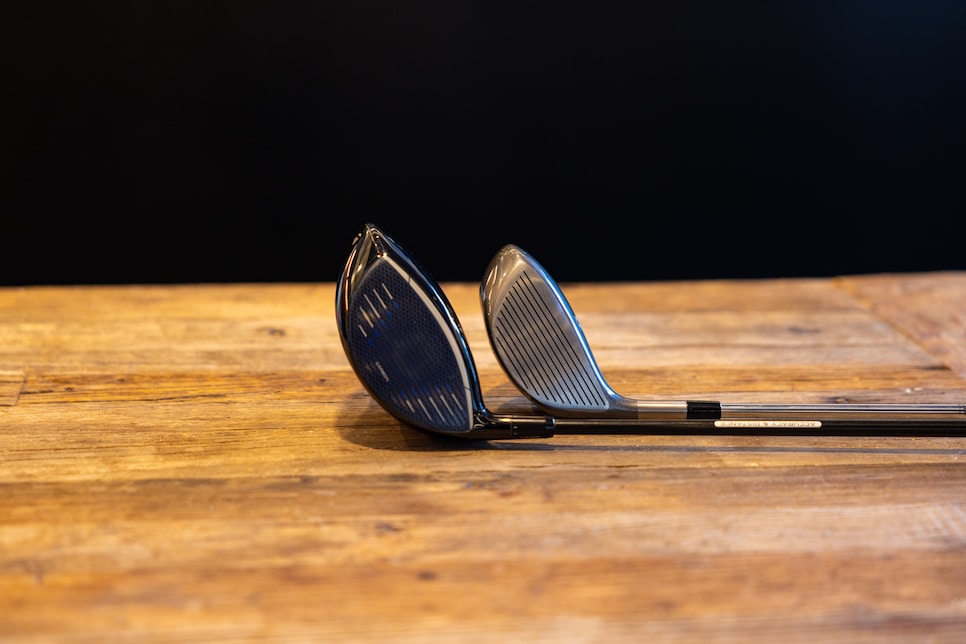
Give 2000 Tiger a 10.5-degree TaylorMade Qi10 LS and a Bridgestone Tour B X, and he blows past all comers. He would've been 24 yards longer than Daly and nearly 40 yards longer than his 975D–Tour Accuracy combo.
TaylorMade Qi10 LS (Bridgestone Tour B X)Ball Speed: 173.5 mph | Launch: 10.6° Spin: 2,093 RPM | Distance: 330.8 yards
The launch was higher, the spin more efficient, and the total distance was simply on another planet.
Just as telling were the mishits. Toe strikes produced the same ball speed and distance as center shots — an almost unbelievable testament to how far forgiveness has come. Heel misses, on the other hand, still lost 22 yards (more than either 975D combo), and dispersion widened to 17.4 yards.
Interestingly, the tightest heel-toe dispersion of the entire test came from 975D-Pro V1 at just 5.5 yards, making it an interesting topic of discussion for those who believe tour pros should play drivers with smaller profiles. Maybe there’s more to accuracy than head size alone.
Twenty-five years later, the GOAT still shapes the gameTiger turns 50 with a body that’s taken more hits than most athletes could survive — and with gear that looks nothing like what he used during the Tiger Slam. This test acted like a time machine, showing the gap between eras and offering a glimpse at an alternate history.
The 975D remains iconic. The Qi10 LS demonstrates what two decades of engineering brilliance can produce. And the results reinforce a simple truth: Tiger wasn’t great because of his equipment. But had he possessed today’s technology during that historic run, he absolutely would have been longer.
And that’s a terrifying thought.
Category: General Sports


