
OKC was on pace to sprint past 73 wins but has been playing .500 ball for the better part of a month.
It feels like just yesterday that much of the NBA-discussing world was wondering whether the Oklahoma City Thunder were not only about to smash the league’s all-time record for wins in a single season, but whether the defending NBA champions’ two-way dominance had become so all-consuming and so inescapable that it would lead even teams with title aspirations of their own to just punt on the pursuit.
It feels like just yesterday, but it wasn’t. It was in the Long, Long Ago of Three Weeks Back. The Before Time — the era when the gravest crisis in Oklahoma City was the Thunder losing a second game, this one to a just-returned alien.
But a funny thing happened on the way to history: The Thunder lost a third. And a fourth. And a fifth. And a SIXTH — to the Charlotte Hornets, of all teams, in what was, by some reckonings, one of the most surprising blowout results in decades.
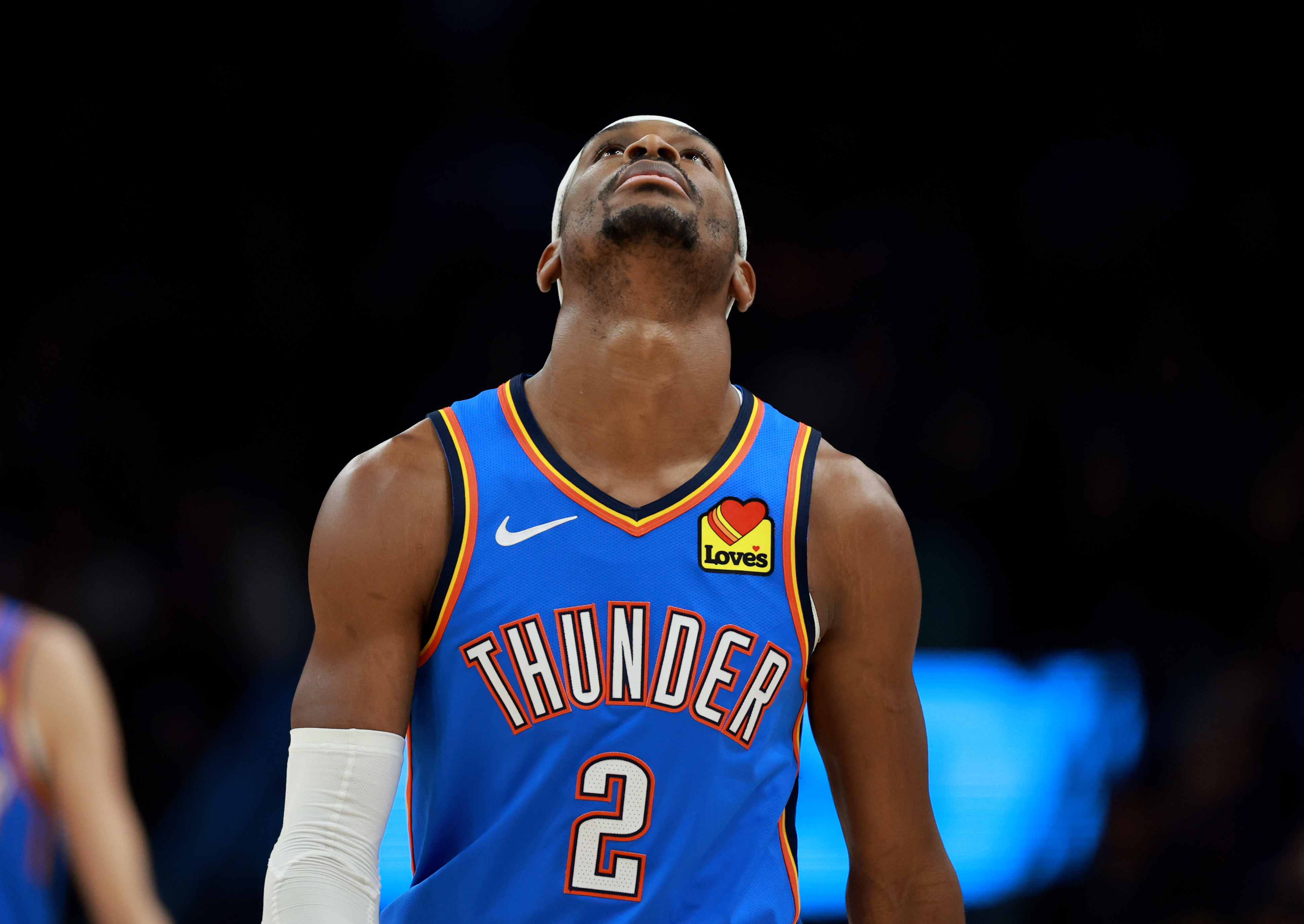
Suddenly, a team that was on pace to sprint past 73 wins has been playing .500 ball for the better part of a month. And it came vanishingly close to falling south of that border on Wednesday, too — needing a fourth-quarter comeback and some Shai Gilgeous-Alexander heroics just to hold off the Utah Jazz, owners of a 12-24 record and the NBA’s worst defense, at home.
Wins are wins, and you don’t have to apologize for taking them where they come. They aren’t all created equally, though — and narrowly avoiding another slip-up didn’t do much to quell the concerns of those who’ve spent the last few weeks wondering how what had previously looked like such a historic team can suddenly look so humble.
Thunder swingman Jalen Williams offered a pretty balanced take on that following the narrow escape:
Jalen Williams brings some perspective to the Thunder’s rough stretch.
— Michael Martin (@MichaelOnSports) January 8, 2026
“This is like gonna sound cocky, but the last three years we win so much that when we have a normal human stretch of losing a game or two that we shouldn’t have the world freaks out.” pic.twitter.com/K0hCJJGyF2
“I think everything’s about perspective,” Williams said. “This is going to sound cocky, but the last three years, we win so much that when we have a normal, human stretch of losing a game or two that we shouldn’t have lost, the world freaks out. [...] Like, we’re not superheroes. We have human moments. We get physically and mentally tired throughout the season. And I feel like that kind of showed, just in that stretch, and that’s something that we just get to work on, get better with.”
It’s a dramatic shift in tone from the “Are they going to win 75 games???” talk that some of us engaged in, but the man’s got some points. (And, to be fair: It’s not like he was the one putting the 2025-26 Thunder next to the 2015-16 Warriors.)
Since the start of the 2023-24 season, nobody has more wins (156) or a higher winning percentage (.772) than Oklahoma City. When a team wins more than three-fourths of the time, there aren’t exactly a whole lot of opportunities to get used to it losing consecutive games — which the Thunder have done twice in the last three weeks after doing it twice all of last season — let alone experiencing an extended stretch of malaise. When you’re accustomed to privilege, equality feels like oppression; when you’re accustomed to a 60- or 70-win pace, .500 ball feels like a crisis.
NBA Cup hangover?
The “physically and mentally tired” thing might have some legs. On this week’s episode of The Big Number, Tom Haberstroh and I looked into whether teams, like the Thunder, that make the semifinals of the NBA Cup experience a “hangover” in the weeks following their trips to Las Vegas …
… and while the sample size is still small, the number of games those Vegas teams have played lately isn’t. Wednesday’s win over the Jazz marked Oklahoma City’s 12th game in 21 days since the end of the tournament — a stretch that has included four back-to-backs. Nine NBA teams have played a dozen games in that three-week span, including all four semifinalists (the Knicks, Spurs, Thunder and Magic), with a combined record of 53-55 — a .491 winning percentage). By contrast, the 10 teams that have played either nine or 10 games in that same timeframe have gone 55-44 — a .556 winning percentage.
Your mileage may vary on just how much you think a couple of extra games’ worth of miles over a couple of weeks add up. It might show up, though, in the legs on your jumper, where a Thunder team that was splashing 38.1% of its 3-point shots through its 24-1 start, fifth-best in the NBA, has dropped down to 31.8% since its NBA Cup semifinal loss, fifth-worst in the league in that span.
It’s been a contagious cold snap for a Thunder offense that ranked fourth in offensive efficiency through 25 games and has dropped to 18th since, with rotation mainstays Cason Wallace, Luguentz Dort, Aaron Wiggins and Isaiah Joe all shooting below 40% from the field over the past three weeks, and SGA, Wallace, Wiggins and Alex Caruso all under 30% from 3-point land.
Injury issues
The absence of starting center Isaiah Hartenstein, who’s missed the last six games with a right calf strain, hurts, too. With him on the floor, the Thunder grab offensive rebounds at a top-10 rate. With him on the sideline, they perform like the worst offensive rebounding team in the league — a particular bummer when there are more misses to corral than there used to be. (OKC dropping from a top-five defensive rebounding team through its 24-1 start to 16th in clearing the defensive boards during this lull hasn’t helped, either.)
Some of those misses have been coming off the right hand of Williams, who began his ascent as Gilgeous-Alexander’s running buddy two seasons ago and cemented himself as a cornerstone in his own right last season, earning All-Star, All-NBA and All-Defensive honors and authoring an iconic 40-point performance in the NBA Finals to help propel the Thunder to the championship. After missing the first 19 games of the season rehabilitating following offseason surgery on his right wrist, though, Williams has struggled to recover his shooting touch.
Williams’ accuracy is down everywhere but the free-throw line this season — most notably from midrange and beyond the arc — contributing to a true shooting percentage of .536, which would be the worst mark of his four-year NBA career. It’s also one of the worst among high-volume offensive players in the league thus far this season: Of the 53 players this season who’ve played at least 500 minutes and have a usage rate of 25% or higher, Williams’ TS% ranks 48th — ahead of only Brandon Miller, Jordan Poole, Russell Westbrook, Jeremiah Fears and Ja Morant.
It seems reasonable to give Williams a little bit of grace amid his shooting slump, considering it hasn’t even been six weeks since Williams came back from surgery to repair an injury that literally forced him to re-learn how to shoot the basketball, and that he’s trying to get back to full speed without the benefit of training camp or preseason. A player using that many possessions that inefficiently does have an impact on your offense, though: The Thunder are scoring like a league-average unit in J-Dub’s minutes, and at a league-worst rate in the minutes he’s played without Gilgeous-Alexander.
‘You can’t be at a playoff level every single night’
Another place that the additional post-Cup workload could show up? Execution in close-and-late situations.
Heading into the semifinal against San Antonio, the Thunder were 9-1 in “clutch” games — defined by the NBA as contests in which the score was within five points in the final five minutes of the fourth quarter or overtime — with a league-best 136.7 offensive rating and just three turnovers in 90 crunch-time minutes. Since? They’re 2-3 in the clutch with a 119 offensive rating, shooting just 20-for-55 (36.4%) from the field and 5-for-25 (20%) from 3-point range.
One of those losses — a 108-105 defeat at the hands of the better-than-anyone-outside-Phoenix-imagined-they-could-be Suns — came on an absolute honey of a game-winner by Devin Booker; sometimes, great offense beats even the best defense on the planet. That’s the thing, though. For two months, the only pathways to beating the Thunder seemed to be “get them to run out of gas on the second night of a back-to-back on the road” or “have a gigantic anomaly and three star guards, and play perfectly.” Now, it’s become clear that there’s more than one way to get them. Now, you know they bleed.
[Get more Thunder news: Oklahoma City team feed]
“It’s a competitive privilege to be a team that other teams are up to play for,” Thunder head coach Mark Daigneault said Monday, according to Joe Mussatto of The Oklahoman. “And it forces you to rise to that. And if you can, you really can get better and stronger as a result of that. And if you don’t, you learn the lesson. We got to learn the lessons in these ones.”
One of the lessons Williams has taken from this uncommon glitch in Oklahoma City’s unnervingly efficient opponent-mashing machine? Life in the NBA isn’t always so smooth.
“Every team this year has lost a couple of games that they wish they could have back,” he said Wednesday. “We understand that it’s just like: How many of those can you limit during the season? And how much better can you get because of it?”
The prospect of the Thunder getting better — by getting Hartenstein (and backup big Jaylin Williams, who has missed the last 12 games with right heel bursitis) back in the fold, by thawing out those frosty jumpers, by doing a better job of finishing possessions — ought to be a scary one, considering they’re still, even in this somewhat diminished form, good enough to beat anyone on any night. (Well, maybe not anyone.)
What three weeks of hiccups have made clear, though, is that they’re not dominant enough to beat everyone on every night, irrespective of who’s in or out of the lineup. Especially when the price of wearing the crown is taking every team’s best shot, without a breather in sight or any quarter given.
“You can’t be at a playoff level every single night in the NBA,” Caruso recently told Joel Lorenzi of The Athletic. “You’ll burn out. There’s no way for you to play like that for 82 games.”
Combine that with the vicissitudes of 3-point variance and the injury gods, and sometimes — even multiple times — even Goliath can get got.
Category: General Sports


