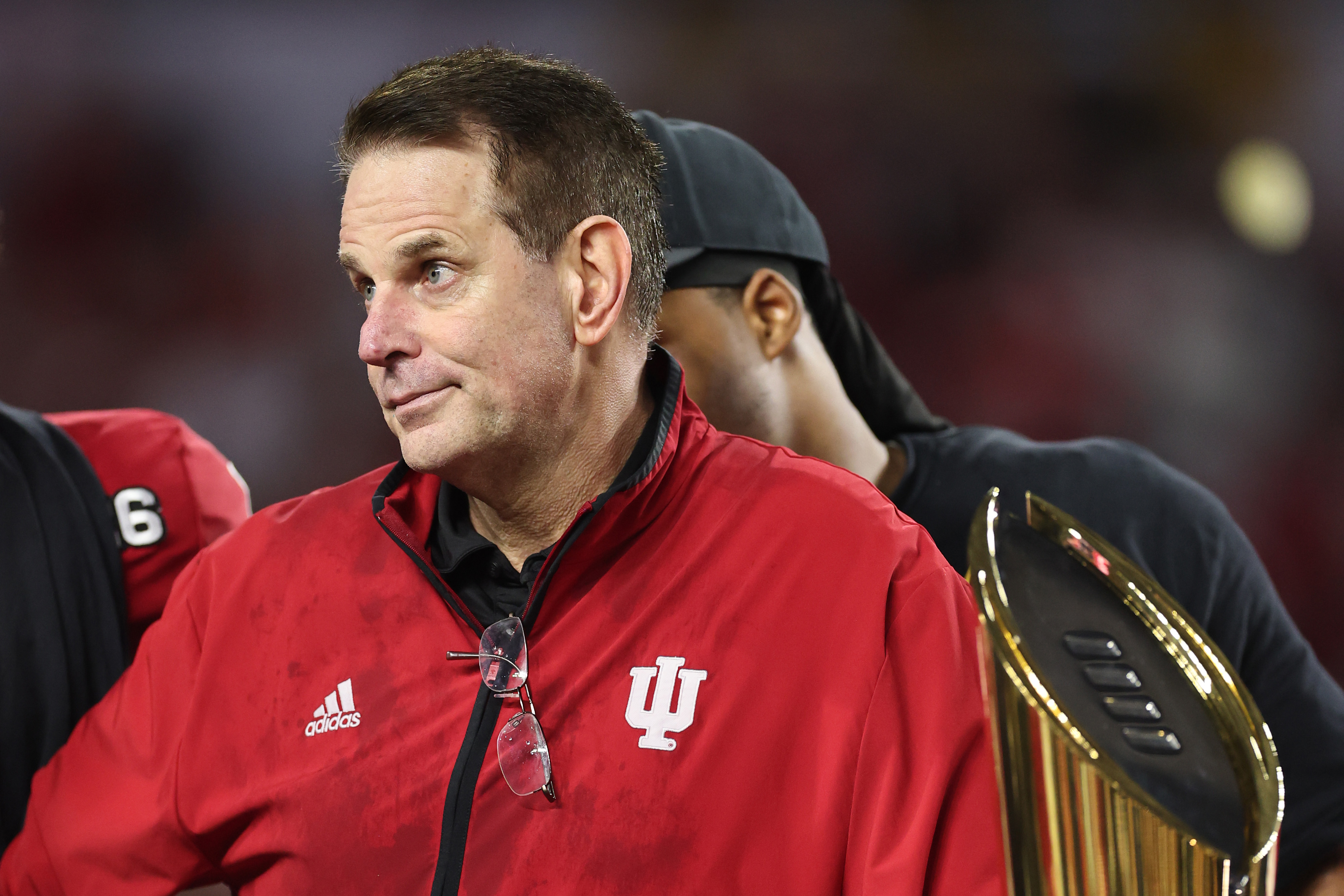
MIAMI GARDENS — The field was covered in red-and-white confetti, and the Heisman Trophy quarterback was covered in bruises. The college football season had just come down to the very final minute, and a team of perpetual sorrow was dancing toward glory.

MIAMI GARDENS — The field was covered in red-and-white confetti, and the Heisman Trophy quarterback was covered in bruises. The college football season had just come down to the very final minute, and a team of perpetual sorrow was dancing toward glory.
This is what it looks like when reality surpasses fantasy.
No. 1 Indiana, emerging from a century of gloom, won the College Football Playoff national championship game, 27-21, against No. 10 Miami on Monday night in what feels like a seismic shift in possibilities for forgotten programs everywhere.
Were they watching Monday night in Starkville, Mississippi?
How about in Ames, Iowa? Maybe even in the shadow of a new campus stadium in Tampa?
“We’re 16-0 and national champions at Indiana University,” head coach Curt Cignetti said. “I know a lot of people thought that was never possible. It’s probably one of the greatest sports stories of all time.”

The Hoosiers, a team that had not won a conference championship in nearly 60 years and was more than 200 games below .500 before Cignetti arrived in 2024, went 16-0 and won the national championship just two years after going 3-9. If that kind of turnaround is possible in the new world of college football, can any dream be considered too outlandish in the days to come?
Quarterback Fernando Mendoza, who grew up just miles from Hard Rock Stadium and was all but ignored by his beloved University of Miami as a Columbus High senior, played a virtually flawless game despite a fierce pass rush from the Hurricanes.
“Tonight is going to be an insane night,” Mendoza said during the onfield trophy presentation. “I can’t wait to get back to Bloomington with the guys.”
There was nothing accidental about what Indiana accomplished this season. The record was perfect, and it was absolutely a reflection of the team’s play.
The Hoosiers were disciplined (fifth in the nation in penalties per game), they were explosive (second in points per game), they were stingy (second in points allowed per game) and they were smart (first in turnover margin).
They beat defending national champion Ohio State in the Big Ten Championship Game, and then crushed Alabama and Oregon by a combined 94-25 in their first two playoff games. All that stood in Indiana’s way was a Miami team that defied projections with upsets of higher-seeded teams in the first two rounds of the playoffs before dispatching Ole Miss in the semifinals.
The Hoosiers controlled the ball and frustrated the Hurricanes in the first half, and then came up with clutch plays on offense and special teams in the second half as Miami staged a furious comeback.
And, in the end, Indiana’s fearlessness was the difference.

After Miami had cut the lead to 17-14, the Hoosiers answered with a touchdown drive for the ages. It wasn’t that they held the ball for 12 plays or that they traveled 75 yards. It was that Cignetti put faith in his quarterback on a fourth and 5 instead of punting from the Miami 37, and then again on fourth down from the Miami 4. On the first conversion, Mendoza hit Charlie Becker on a 19-yard, back-shoulder completion. That was just the appetizer.
On fourth down from the 4, Indiana initially called the field-goal unit on the field. After a timeout, Cignetti sent the offense back out and Mendoza, on a quarterback draw, bounced off defenders and dove into the endzone for the touchdown.
“They called that play and we knew, ‘Hey, we’re going to bet on ourselves one more time in the biggest (moment) of the game,’” Mendoza said.
In a way, this is what so many fans wanted. A college football postseason with the suspense of an NCAA basketball tournament.
Alabama, Clemson, Georgia and Ohio State had become as ubiquitous in January as Dick Clark and Times Square. From 2014-22, there was not a single national championship game without at least one of those teams. And six of those games included some variation of two of those programs playing each other.
That’s the hierarchy the transfer portal torched. And this is the future that name, image and likeness money has begat.

Miami, on Monday night, was playing in a national title game for the first time in 23 years. The last time Indiana had even a whiff of national title consideration was when the Hoosiers lost 14-3 to No. 1 USC in the 1968 Rose Bowl and finished No. 4 in the final Associated Press poll.
It’s a new era of college football.
It’s not perfect, by any means. It’s not beloved by traditionalists aghast with players jumping from school to school, and it’s practically blasphemous for programs accustomed to sitting atop the mountaintop.
But, as the 2025 season demonstrated, there is something exhilarating about the unknown. Something thrilling about new faces and stories.
Something remarkable about a program that could endure 26 losing seasons in 30 years and, with a new coach on board, emerge to go 27-2 across his first two seasons and win a national championship.
Welcome to the new world order.
John Romano can be reached at [email protected]. Follow @romano_tbtimes.
• • •
Sign up for the Sports Today newsletter to get daily updates on the Bucs, Rays, Lightning and college football across Florida.
Every weekday, tune into our Sports Day Tampa Bay podcast to hear reporter Rick Stroud break down the biggest stories in Tampa Bay sports.
Never miss out on the latest with your favorite Tampa Bay sports teams. Follow our coverage on X and Facebook.
Category: General Sports