Indiana’s title will probably lead to schools throwing a lot of good money after bad, only to find out that it isn’t so easy to pull off anything close to what the Hoosiers just accomplished.
College athletics is, if nothing else, the ultimate copycat industry. Whenever somebody has success doing something unique, dozens of struggling programs will try to beg, borrow and steal whatever they can from that blueprint.
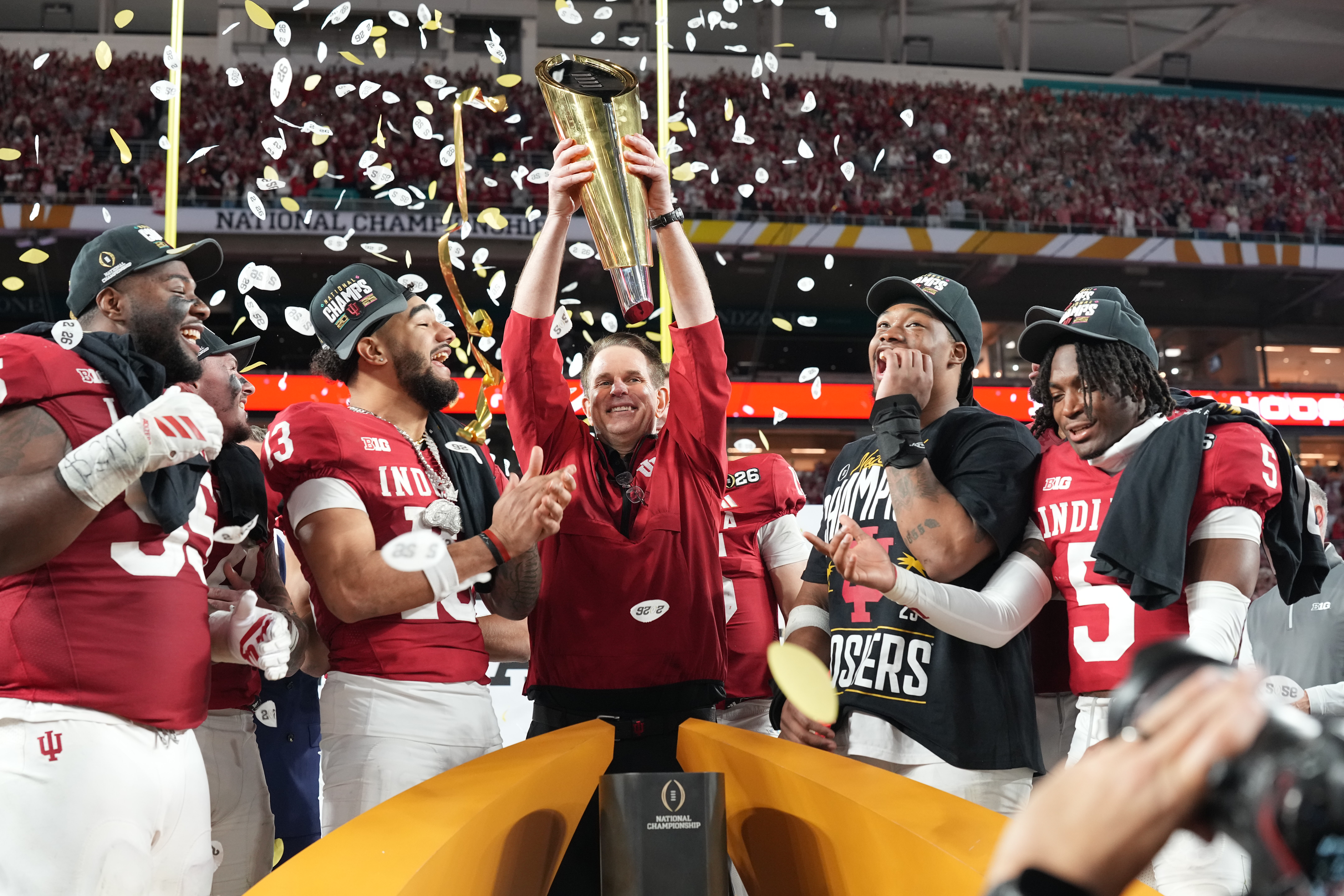
There is no real precedent, however, for how the broader world of college athletics is going to react to Indiana winning a national championship in football. In a sport that has always been tilted toward the pedigreed programs, watching a perennial loser cap a 27-2 two-year stretch with a title is such a one-off that it’s hard to know exactly what the takeaway should be for everyone else.
Does it mean suddenly anything is possible for the middle and lower class of the sport? Has it ruined the excuses of every program struggling to achieve great things? Are there other Curt Cignettis out there who can build a national champion out of three-star recruits and a few hits in the transfer portal?
Here’s the real answer: Probably not. But that isn’t going to stop a whole lot of similarly situated schools from chasing the idea they can become “the next Indiana.”
Who can blame them after watching Hoosier fans suddenly activated after decades to take over the Rose Bowl, the Peach Bowl and even outnumber Miami fans in their home stadium for the national championship game? What administrator could resist the idea that football success is going to get billionaire alums like Mark Cuban to write big checks to the athletic department for the first time?
“I think we sent a message, first of all, to society that if you keep your nose to the grindstone and work hard and you've got the right people, anything's possible,” Cignetti said. “In our particular situation in the athletic world, college football has changed quite a bit. The balance of power also.”
Though nobody could have envisioned a national title within two years, Indiana’s administration led by athletic director Scott Dolson and president Pamela Whitten were not shy about saying that the school needed to invest more and build a winning football program. The subtext of that move, after decades of relative apathy, was that Indiana might be at risk of getting left behind if there was ever a so-called super league of the top 30 or 40 programs that broke away from everyone else.
Indiana certainly isn’t the only school that has that fear. Fundamentally, though, athletic departments will have to ask themselves whether Indiana is a comet or a blueprint.
Because the reality of college sports is that no matter how much anybody invests in a particular sport, there are limits to the number of wins available. Half the teams in college football still lose every week regardless of what it costs to put the product on the field. And in most cases, particularly in the NIL era, giving money to one sport is probably going to negatively impact another.
That’s where Indiana’s success has been a little bit scary for men’s basketball coaches. When their administrations start to feel the pressure of “If Indiana did it, we can too,” will they continue to feed their other sports or try to double down on football like Indiana?
“There’s probably some root fundamental questions that never had to have been directly answered that have to now like, ‘What do we want to prioritize?’” one men’s basketball general manager at a power conference school told Yahoo Sports. “Most of the people that run athletic departments have never felt the pressure of turning a profit.
“[Cignetti] signed an 8-year, $93 million deal. That’s a lot. Their stadium doesn’t have 100,000 seats. If their roster ends up costing them $35 million a year, the question has to be asked, will they make it back?”
Right now, nobody at Indiana cares. They’re drunk on what Cignetti has built, and it’s easy to say the investments have and will continue to pay off when you’re holding a national championship trophy.
But only one team wins the title every year. And it’s not like Indiana is the first school in history to spend a whole lot of money trying to reverse their football fortunes. They just happened to pull it off at an unprecedented level — probably because they caught lightning in a bottle with an overlooked coach in his 60s who was willing to take on the challenge.
“So what is the best use of your funds?” the general manager continued. “At certain places, if you’re at Ohio State, yeah, maybe the best use of your funds is on football. But I can promise you this — it costs a lot of money to run Ohio State football. It’s easy to say, ‘Yeah, go all in on football.’ But even if you reach the absolute ceiling, are schools like Kansas or Arizona or North Carolina or UConn ever going to be football first? And that’s nobody’s fault, it’s just what it is. So is it a sound business decision to go that route or to invest in our strength and make it profitable?
“It might make sense for schools to maybe invest more on the basketball side of NIL while everyone is running to football.”
There’s no one-size-fits-all answer here. Every school has a different stadium size, a different donor base and different budgetary pressures. There are one-off places where a sport outside the traditional profit centers of football and men's basketball really, really matters like LSU baseball, Nebraska women’s volleyball, Minnesota hockey and Utah gymnastics.
Realistically, though, King Football rules all those campuses in terms of dollars and institutional priorities. If anything, Indiana’s title will probably lead to schools throwing a lot of good money after bad, only to find out that it isn’t so easy to pull off anything close to what they just accomplished.
One thing’s for sure: Cignetti won’t be inviting a bunch of coaches to Bloomington this spring to share his secrets.
“I'm sure we've got some people's attention,” he said. “I'm not one to entertain visitors too much in the office. I prefer to watch tape and keep growing and learning. I think anything is possible with the right commitment, leadership, blueprint, plan and people.”
Category: General Sports