
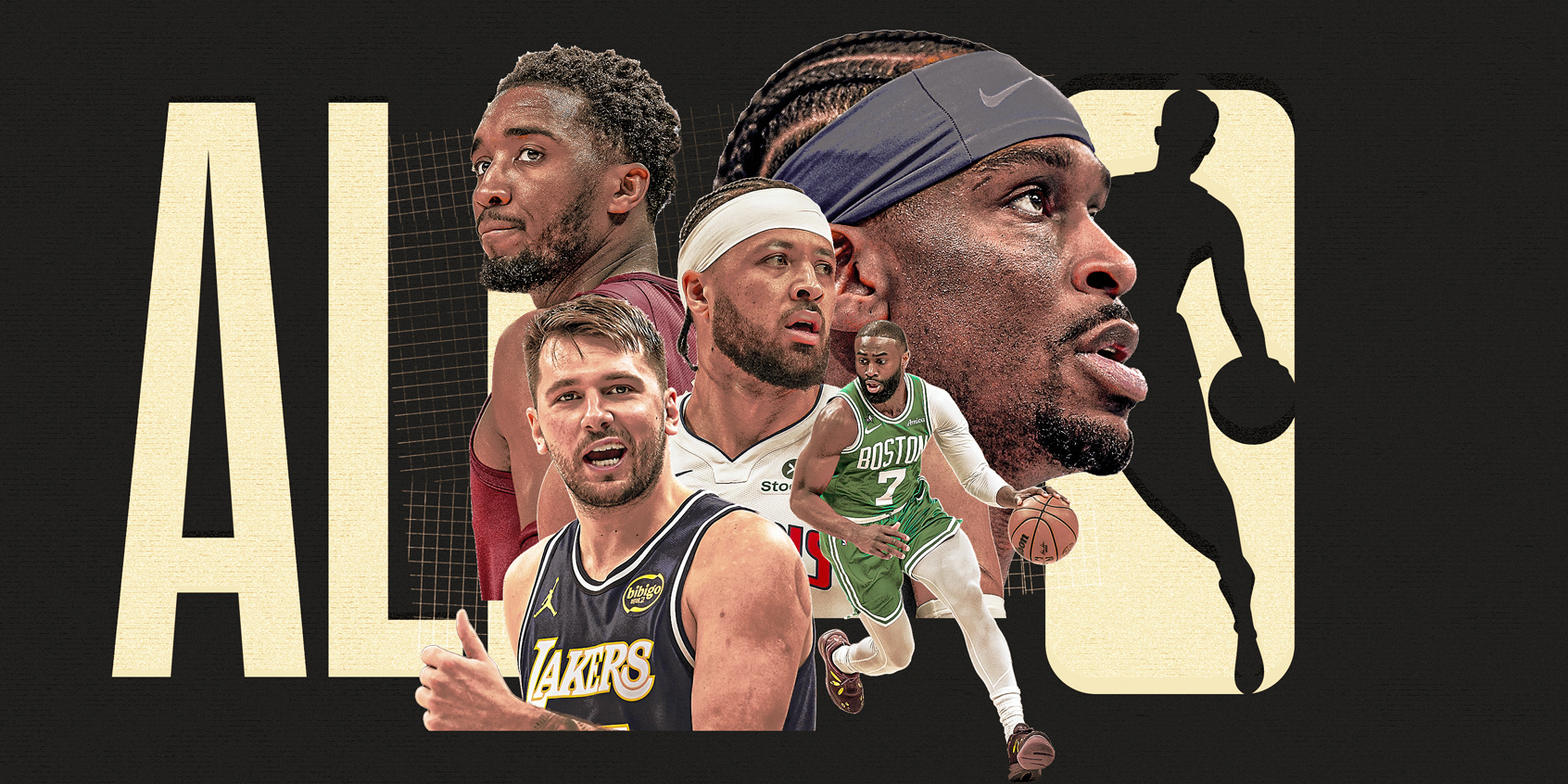
Here's a snapshot of what these teams could look like a little past the halfway point of the season.
This year’s award races, particularly All-NBA honors, will be incredibly difficult to suss through. There are always a ton of great individual performances across the league, so in a literal sense you can’t highlight everyone. Once you factor in the 65-games played minimum, the field simultaneously shrinks while making decisions even more difficult in some cases.
In light of today’s exercise, taking a snapshot of what these teams could look like a little past the halfway point of the season, I’ll be selecting from the pool of players that are currently on pace to be eligible by the end of the year. Playing 65-of-82 means logging a qualifying appearance in roughly 79% of your team’s games.
To that end, here’s a list of notable names who are noton that pace right now, and thus won’t factor into my calculus — at least not yet. Chief among them:
Nikola Jokić (32 games out of 48, 66.7%)
Giannis Antetokounmpo (30/46, 65.2%)
Victor Wembanyama (33/47, 70.2%)
Stephen Curry (38/49, 77.6%)
Kawhi Leonard (33/46, 71.7%)
Lauri Markkanen (35/48, 72.9%)
Paolo Banchero (36/46, 78.3%)
And here are a few names that have already been eliminated from contention:
Joel Embiid (27/47, 57.4% – max of 62 games)
Austin Reaves (23/46, 50% – max of 59 games)
Jimmy Butler (39 games, out for season)
Franz Wagner (26/46, 56.5% – max of 62 games)
Let’s dig in, shall we?
All-NBA First Team
Jaylen Brown, Celtics
Stats: 29.4 points (53/36/78 shooting splits), 6.8 rebounds, 4.9 assists, 1.0 steals
Brown has been the focal point of one of the best stories — and teams! — in the NBA this season. His blend of drives, pull-up jumpers and improved playmaking have helped spearhead the league’s second-best offense in Boston. The fact that he has the on-ball chops to take on tough defensive assignments when asked and locked in — remember, he opened the season with the Joel Embiid matchup, and notably took the Kawhi Leonard assignment in the same game he dropped 50 points — is a welcomed bonus, and a glimpse into the kind of two-way impact he can tap into.
Cade Cunningham, Pistons
Stats: 25.3 points (51/32/82 shooting splits), 5.7 rebounds, 9.7 assists, 1.5 steals, 0.8 blocks
Carrying high usage is a tough job. Doing so for a good team comes with added pressure and responsibility. Doing so while leading defensively slanted lineups, thus cramping the room you have to operate with, adds another layer of difficulty. That Cunningham has been this good, leading the league in assists while knocking down countless pull-ups (and sprinkling in post buckets) in the process, is a testament to his talent and basketball mind. There are many reasons why the Pistons have been the best team in the East, and quietly 2.5 games back of the league’s best record. Cunningham’s at the top of that list.
Luka Dončić, Lakers
Stats: 33.6 points (58/34/78 shooting splits), 7.7 rebounds, 8.7 assists, 1.5 steals
A historically dominant offensive player already, Dončić has somehow managed to raise the bar for himself in the midst of injury and general lineup uncertainty. Converting 58% of his 2s while rarely being able to get to the rim, and with roughly 80% of those inside-the-arc shots being self-created, is patently absurd. There isn’t a pass he can’t make, and he’s pretty much impossible when he has his 3-ball going. The Lakers wouldn’t be in the top-six without his efforts.
Shai Gilgeous-Alexander, Thunder
Stats: 32.0 points (61/39/89 shooting splits), 4.4 rebounds, 6.2 assists, 1.3 steals, 0.8 blocks
The frontrunner for MVP, Gilgeous-Alexander has further cemented himself as the league’s preeminent off-the-dribble scorer. He drives more than virtually anyone, sprinkles in an ungodly amount of midrange jumpers (making them at a career-best 55% clip), and has shown greater comfort taking 3s off the dribble, too. Take your pick at beyond-the-box-score numbers — the Thunder blitzing teams by over 14 points per 100 possessions with him on the floor, leading on-pace-to-qualify players in Dunks And Threes’ Estimated Plus-Minus (EPM) metric — and he’ll grade out well. He’s the primary reason the Thunder sport the league’s best record.
Donovan Mitchell, Cavaliers
Stats: 29.4 points (57/38/84 shooting splits), 4.8 rebounds, 5.8 assists, 1.5 steals
Darius Garland has been in and out of the lineup. Evan Mobley has made more of a hop than a genuine leap this season, and is currently out of the lineup. There was a time this season where you didn’t know how much of Jarrett Allen you’d see in the second halves of games, much less crunch time.
The lone constant of the Cavs, who’ve won five straight and now sit one (1) game outside of the two-seed, has been Mitchell. He’s shot the leather off the ball on ridiculous volume, unleashed a bevy of creative midrange buckets, and often finds himself threatening enemy lines at the rim, one windmill gather at a time. It’s easy to say the Cavs need him, but the numbers tell that story, too: per Cleaning The Glass, the Cavs have the point differential of a 57-win team with him on the floor, and a 32-win team with him on the bench.
[Subscribe to Yahoo Sports NBA on YouTube]
All-NBA Second Team
Jalen Brunson, Knicks
Stats: 27.6 points (53/38/85 shooting splits), 3.2 rebounds, 6.0 assists, 0.6 steals
Brunson doubles as an insanely talented scorer and an infuriating player to defend. The list of guards that possess Brunson’s bag of pivots is a short one; his footwork is rivaled by few, especially if you filter for guys his size. Throw in an increasingly willing trigger from deep (career best 7.6 attempts) and continued growth as an interior passer — there’s still more room to grow against aggressive coverages — and you have a problem on your hands.
Kevin Durant, Rockets
Stats: 26.5 points (56/41/89 shooting splits), 5.4 rebounds, 4.5 assists, 0.7 steals, 0.9 blocks
Durant continues to climb up the record books, one silky-smooth jumper at a time. He’s been as-advertised in his first season as a Rocket, his bucket-getting raising the floor and ceiling of an offense that desperately needed his skill set. He shapeshifts into whatever is needed — a spacer, iso threat, post hub, screener (he’s been hitting folks, lowkey) — and forces defenses to think hard about how they want to handle him and whatever action surrounds him.
Anthony Edwards, Timberwolves
Stats: 29.3 points (55/41/79 shooting splits), 5.2 rebounds, 3.7 assists, 1.3 steals, 0.8 blocks
Edwards has leveled up in multiple areas, leading to the best offensive season of his career to this point. Nobody as athletic as Edwards should be this good of a pull-up shooter from deep. That he’s also refined his midrange and post-up game makes him more dangerous — and those skills in particular should bode well once the postseason rolls around. Similar to Brown, Edwards has also shown that, when he locks in, he can be a strong on-ball defender willing to take on tough assignments in key moments. Speaking of key moments, Edwards has been insanely efficient in clutch situations. Keep an eye on him in the Clutch Player of the Year race.
Tyrese Maxey, 76ers
Stats: 29.4 points (53/39/89 shooting splits), 4.2 rebounds, 6.9 assists, 2.0 steals, 0.9 blocks
Maxey has taken another step, arguably cementing himself as the Sixers’ best — or at the very least, most important — player this season.
His speed alone causes trouble for defenses, both in transition and in half-court situations. The Sixers have smartly weaponized that, along with his shooting, with more off-ball involvement. He flies off of screens every which-way, and sets quite a few of them in his own right. Even without fluff, Maxey can (and will) win with straight-line drives. If your defense is bent at any time, he’ll make sure it’s broken.
Jamal Murray, Nuggets
Stats: 25.9 points (52/44/88 shooting splits), 4.3 rebounds, 7.3 assists, 1.0 steals
The usual Murray script is being good-not-great at the beginning of a season, usually taking a little time to gain a rhythm as a shooter and driver before turning into a monster. This year, Murray’s been near or at the top of his game from the very beginning.
He’s enjoying the best shooting season of his career, and continues to infuriate guards with his blend of pick-and-roll chops, off-ball utility, shifty drives and occasional post-ups. While the partnership between him and Jokić has once again been excellent, Murray has been a monster — 27.8 points on 54/41/87 splits, 4.2 rebounds, 8.3 assists — since Jokić has been out. First-time All-Star and All-NBA honors are well-deserved right now.
All-NBA Third Team
Deni Avdija, Trail Blazers
Stats: 25.8 points (54/36/80 shooting splits), 7.2 rebounds, 6.8 assists, 0.8 steals, 0.6 blocks
It’s kinda funny watching teams deal with Avdija. Nobody is driving more on a per-game basis than Avdija (19.9), edging out Jaylen Brown (18.5) and SGA (18.4) for those honors. Nobody drives going right more than Avdija (576); Mitchell is second on that list with 390. The scouting report is obvious. There are no surprises, and yet, Avdija gets to his spots — and to the free throw line — almost at will.
He has carried this Blazers offense, particularly during their extended stretch without Jrue Holiday. To that point, the Blazers score at a top-10 level with Avdija on the floor, and score at a much lower clip than the league’s worst offense when he sits. That, combined with the rarity of his basic box score — he’s one of six players averaging 25-5-5, and the list shrinks to three when bumping it to 25-7-6 — makes for a compelling All-NBA case.
Scottie Barnes, Raptors
Stats: 19.4 points (55/31/83 shooting splits), 8.3 rebounds, 5.6 assists, 1.3 steals, 1.5 blocks
While it’d be understandable because of the league’s depth, it’d be a shame if Barnes wasn’t rewarded for his all-around excellence this season. Not many players have to toggle as many hats as he does: primary playmaker, secondary playmaker, screener, post hub, mismatch hunter, wing defender, big defender, guard defender, backline clean-up guy, full-court pressure weapon.
The Raptors wouldn’t be a top-four team in the East, only a game out of the two-seed as of this writing, without Barnes filling as many roles and gaps as he does. He’s put together an All-Defense caliber season — and his Defensive Player of the Year case at least deserves some examination.
Devin Booker, Suns
Stats: 25.4 points (52/31/86 shooting splits), 4.0 rebounds, 6.2 assists, 0.9 steals
There’s stiff competition for the We Didn’t Think You’d Win This Much award between the Celtics (no Jayson Tatum), Sixers (alllll of the health concerns), and Suns (no Durant, no Bradley Beal, new head coach).
The Suns may still have my vote. The defense has led the dance, but the offense has been spearheaded by the versatility of Booker. He’s a bucket in his own right, constantly receiving picks to zoom through before attacking bent defenses. Because of his gravity and willingness to operate off the ball, it’s made it easier for the players around him to break out. Dillon Brooks, Collin Gillespie, Grayson Allen and others aren’t able to thrive to this degree without Booker’s approach — and the fear that his presence alone unlocks.
(Also, while I wouldn’t make an All-Defense argument for Booker, I do think it’s worth noting his level of buy-in defensively.)
Julius Randle, Timberwolves
Stats: 22.2 points (56/33/82 shooting splits), 6.9 rebounds, 5.3 assists, 1.2 steals
The list of players averaging at least 20-6-5 is only seven-deep — really five-deep considering Jokić and Giannis aren’t factoring in for me right now. Either way, Randle is on that list, and has been quite efficient (59.8 true shooting) while doing so. His blend of chest-caving drives and playmaking have been important to Minnesota’s offense. It’s been especially important when Edwards hasn’t been on the floor; the Wolves have not only won the Randle on, Edwards off minutes, their offense has largely tanked without Randle on the floor, period.
Chet Holmgren, Thunder
Stats: 17.8 points (66/38/77 shooting splits), 8.6 rebounds, 1.6 assists, 0.6 steals, 2.0 blocks
Holmgren’s case is pretty straightforward: he’s been an insanely efficient play-finisher, has grown as a self-creator — a career-high 37.7% of his 2s have been unassisted; the drives and turnaround jumpers in particular have been fun — and is a, if not the, frontrunner for Defensive Player of the Year. Opponents are converting roughly 47% of their shots at the rim against Holmgren, the second stingiest mark in the league (Isaiah Stewart, 43.4%) among 56 players defending at least four rim attempts per game.
On The Bubble
Jalen Duren, Pistons
Stats: 17.9 points (64/0/72 shooting splits), 10.6 rebounds, 1.7 assists, 0.9 steals, 0.9 blocks
Duren has, figuratively and literally, been at the center of the Pistons’ success this year. Operating as the primary screening partner for Cunningham, Duren has consistently pried Cunningham open for fruitful pull-ups and drives while becoming more of a threat in his own right. He’s grown as a short-roll playmaker, feasted on midrange jumpers all year, and been a devastating driver when he has room to operate. Add in the defensive growth, and it wouldn’t surprise me if he winds up making quite a few ballots this year.
James Harden, Clippers
Stats: 25.4 points (49/35/90 shooting splits), 4.8 rebounds, 8.1 assists, 1.3 steals
In a way, I feel for Harden. He was the metronome of productivity while the Clippers got off to one of the worst starts in franchise history. They’ve since turned it around, driven primarily by the currently ineligible Leonard, but it’s not like Harden hasn’t been hooping in his own right. His blend of drives, playmaking, stepback jumpers and foul-drawing still makes him one of the best offensive players we have in the league.
Jalen Johnson, Hawks
Stats: 22.9 points (56/36/78 shooting splits), 10.5 rebounds, 7.9 assists, 1.2 steals
Johnson is the new face of the Hawks following their decision to trade Trae Young, though you could argue the tide was turning before the transaction actually happened. He’s taken on more ownership of the offense, oscillating between pick-and-roll reps, elbow initiation (often after receiving an off-ball screen to set it up) and his usual goodness in transition. His (late) jump-passes excite me; the defense leaves a bit to be desired at this stage, though it’s (sadly) expected in light of his rise in offensive responsibility.
Michael Porter Jr., Nets
Stats: 25.6 points (57/40/85 shooting splits), 7.3 rebounds, 3.2 assists, 1.1 steals
Many expected Porter Jr.’s production to go up in Brooklyn by virtue of the roster context. I’m not sure many expected him to be this good, this efficient (61.8 true shooting) and be weaponized in so many ways. He’s an absolutely lethal shooter, but the chemistry he’s built with Nic Claxton — off-ball work, handoffs, pick-and-rolls — has been one of the underrated joys of the season.
Alperen Şengün, Rockets
Stats: 21.1 points (54/30/69 shooting splits), 9.1 rebounds, 6.3 assists, 1.5 steals, 1.0 blocks
Probably my toughest omission among eligible candidates, Şengün has largely been awesome this season. The Rockets get him the ball at different spots — on the low block, in the middle of the floor, at the elbow, above the break — and unleash him as a scorer and initiator. Defensively, he’s continued to grow (I think he’s firmly good now, hope that isn’t a hot take) and the Rockets smartly deploy him as part of their cross-matching and growing aggression against ball screens. The two nitpicks keeping him off the third team, at least for now:
He’s below league-average in efficiency right now (56.0 true shooting, league average is 57.9), but more importantly for this exercise, he’s behind all five Third Teamers (Barnes is the closest at 57.5).
He’s at a games and/or minutes deficit against all five Third Teamers as well; Randle and Barnes are probably the easiest direct comps to make to Şengün, and they’ve appeared in 10 and nine more games respectively.
Category: General Sports


