Darnold reaching a Super Bowl before his fellow 2018 draft classmates must prompt questions about the range of recipes that can produce a world championship.
SAN JOSE, Calif. — By 6:30 a.m. on weekdays throughout the NFL season, Seattle Seahawks coaches and players could walk past the far left room of their facility and see a meeting in session led by one of two men.
Sometimes, quarterback Sam Darnold manned the computer near the window as he rolled through film, lights off and breakfast already procured. Other times, veteran receiver Cooper Kupp rolled the film. The two would exchange playful ribbing, often jabbing about which arrived to the building first. Then, they would solve the problems most likely to arise in the quarterback-receiver connection.
How should Kupp adjust his route if Darnold is under pressure? Should those adjustments focus more on timing or depth of route?
“They almost look like mad scientists,” defensive pass game coordinator and defensive backs coach Karl Scott told Yahoo Sports. “I don’t know what they’re doing in there, but obviously they’re doing something right.”
The Seahawks, and Darnold, are creating a reality far removed from what Darnold experienced to start his career. The meeting room overlooking an idyllic Lake Washington belies the journey that the California native traveled before landing back on the West Coast.
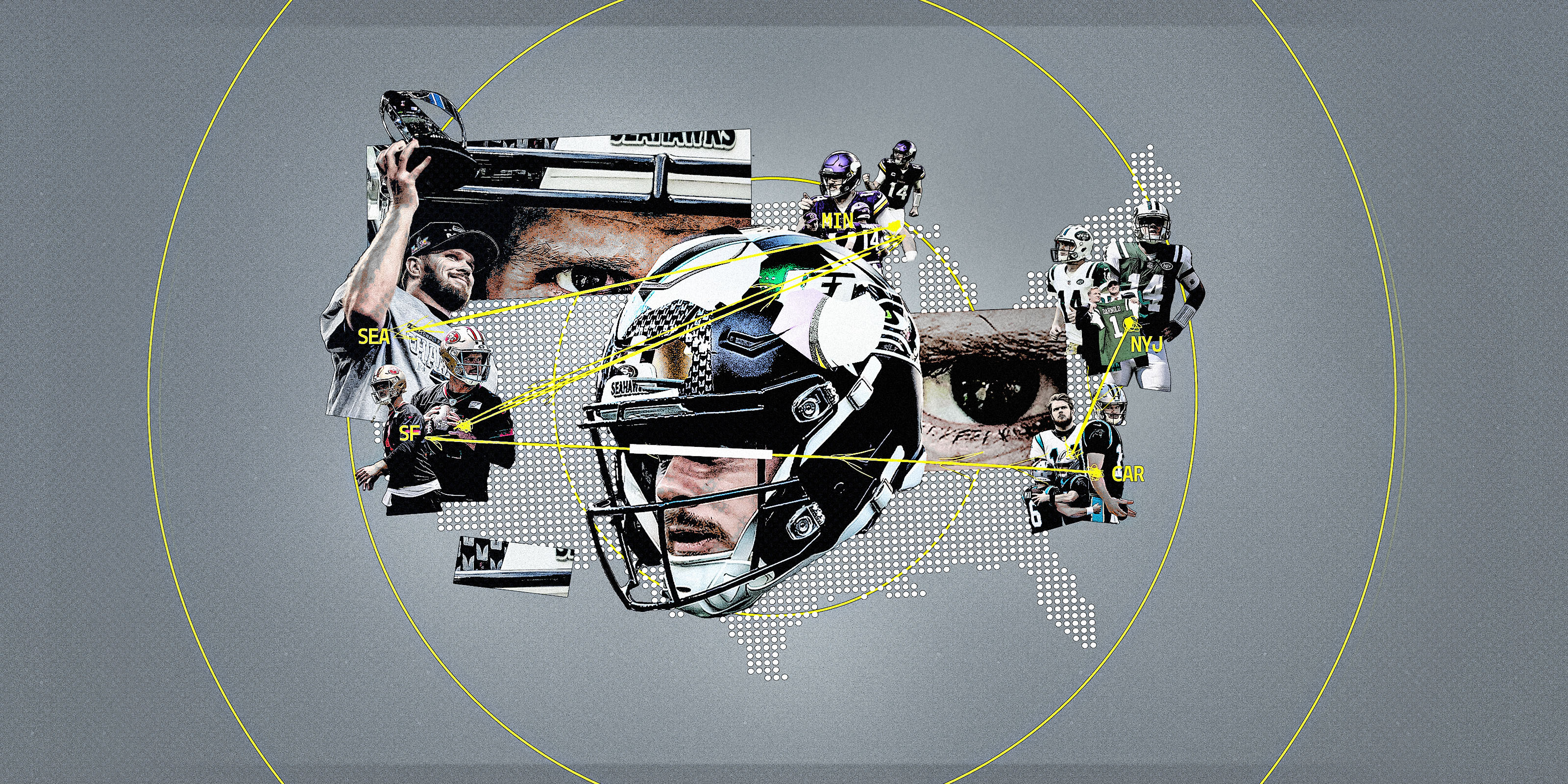
Since he was drafted at 20 years old in 2018, Darnold has started for the New York Jets, Carolina Panthers, San Francisco 49ers (just one game), Minnesota Vikings and Seahawks. The 28-year-old’s fall and subsequent rise may seem storybook. And yet, offensive coordinator Klint Kubiak pushed back on what seems like the obvious lesson of a player reaching his greatest heights in his eighth season.
“You’d like to think patience is the lesson, but the NFL is not about patience,” Kubiak said Monday. “It’s not fair. It’s not a fair league. So the cool thing about the NFL is sometimes you get your tail fired and then you get to go try somewhere else and you just make sure that you got better from that last experience. So myself, players, we all get fired and if we get another chance, then you go make the most of the next opportunity.
“That's what Sam's done.”
What he has the chance to do next is rare.
Sunday, Darnold will become the third quarterback in NFL history to start a Super Bowl after playing for five-plus teams in his NFL career, and the second to start in a season opener for four-plus teams then later start in a Super Bowl. No quarterback has accomplished either in the last two decades. And if Darnold leads a 4.5-point favorite Seattle team to beat the New England Patriots on Sunday, he’ll be the first quarterback to start for four-plus teams and win a Super Bowl.
By Wednesday, Seahawks players and coaches were preaching about his resilience in their sleep, understanding the disbelief surrounding one of the unlikeliest NFL paths in recent years. Even businesses were stunned: The NFL’s official licensing company, Fanatics, issued an apology this week for far underestimating the potential playoff run and related jersey demand the Patriots and Seahawks’ sudden success has elicited. A Hollywood ending is in reach.
“America loves an underdog, rightfully so,” tight end AJ Barner said. “These stories God’s writing right now, no script[writer] could write a better script than this.”
But as he prepares to start on the biggest stage, the phoenix legend begs questions. How did Darnold rise from the ashes of NFL quarterback failure?
League views Sam Darnold as only partially responsible for his early failures
To fully appreciate Darnold’s rise, first understand his fall. The now two-time Pro Bowler and those close to him are not afraid to describe his early career as a period of failure. League talent evaluators identify two key culprits.
The first: Darnold’s relative inexperience. When the Jets spent the third overall pick of the 2018 NFL Draft on a 20-year-old, Darnold had played just two seasons at USC. Darnold ranked fifth in the NCAA with 4,143 passing yards his final season — but his 13 interceptions ranked worse than 509 quarterbacks. He needed molding, which leads to culprit No. 2: Was he at the right place at the right time to receive development?
“Respectfully, the Jets were not the right time,” a high-ranking NFC executive told Yahoo Sports. “And I think they've shown for the last how many years that that's not the right place. [But] the reality of the NFL … is that we’re very impatient.”
Among quarterbacks who started at least 10 games from 2018-2020, Darnold’s 78.6 passer rating ranked 45 of 47. He won fewer games (13) in three Jets seasons than he won this year alone (14).
That led to a third culprit, Darnold admitted this week: spiraling after moments of bad play.
“As a young player, too, early in my career, I was really hard on myself after a bad rep or a bad practice,” Darnold said Wednesday. “I would let it affect my attitude a little bit.”
Years later Darnold would accept: “It’s not always going to be perfect. That’s why everybody loves this game and people call it some of the best reality TV there is.”
After three losing seasons, the Jets dealt Darnold to the Panthers on April 5, 2021. Darnold’s play would improve, particularly during a 2022 stretch when he led the Panthers to four wins in six starts. But Carolina wasn’t sold enough on Darnold not to draft Bryce Young first overall. So on Darnold went to the 49ers, where Brock Purdy was rehabilitating from an elbow injury. Purdy recovered to start all but one game, but Darnold gained something even more valuable: a crash course from head coach Kyle Shanahan, one of the architects of the popular Shanahan-McVay offensive system.
That background, and a training camp meniscus tear to rookie 10th overall pick J.J. McCarthy the following August, would elevate Darnold to Vikings QB1 in 2024. He was still just 27 years old and now entering a system in which he had familiarity with a level of maturity (or scarring, depending whom you ask) and the stars were finally aligning. Darnold lit it up with a 4,319-yard, 35 touchdown-to-13-interception season.
“Guys develop,” Dallas Cowboys executive vice president Stephen Jones told Yahoo Sports of the takeaway. “These quarterbacks, if they get enough time on the job, they just get better.”
Still, struggles in the regular-season finale and a wild-card loss in which he took nine sacks convinced the Vikings to roll with McCarthy’s cost-effective salary rather than pay Darnold. As Seattle offered a three-year, $100.5 million contract with a dose of the belief that four teams had lost, Darnold reunited with former 49ers colleague in Kubiak, now the Seahawks offensive coordinator.
Sam Darnold says 49ers stint with Kyle Shanahan helping him evolve offensively — and perhaps even more valuable, helped him better understand defenses: pic.twitter.com/tk1w15JURH
— Jori Epstein (@JoriEpstein) February 5, 2026
“It kind of gave him a leg up,” quarterbacks coach Andrew Janocko told Yahoo Sports. “Allowed us to kind of get ahead.”
Seahawks’ unwavering in belief in Darnold key ingredient to Super Bowl run
Seahawks colleagues liken Darnold joining Seattle under Kubiak’s coordinating to a student showing up to an exam having already completed a take-home test. He understood much of Kubiak’s terminology and footwork aims; Kubiak, in turn, understood how a strong run game and heavy dose of play action would benefit his quarterback.
The Seahawks began the year 7-2 before Darnold faced the team that had wrecked his rhythm in the playoffs 11 months earlier. Darnold threw four interceptions in a 21-19 loss to the Los Angeles Rams on Nov. 16. Questions about his ability to rise to the moment bubbled, but teammates clapped back.
“If we want to try to define Sam by this game, Sam’s had us in every f***ing game,” linebacker Ernest Jones IV said then. “So for him to sit there and say, ‘That’s my fault.’ No, it’s not. There were plays that, defensively, we could have made plays. There were opportunities where we could have gotten better stops. It’s football, man. He’s our quarterback.
“We’ve got his back and you got anything to say about it, quite frankly, f*** you.”
The Seahawks haven’t lost any of nine games since.
Seven more regular-season wins included an overtime escape from the Rams. Darnold joined Tom Brady as the only quarterbacks in NFL history to lead different teams to 14 wins in consecutive seasons. The Seahawks earned the wild-card bye, then faced a pair of NFC West foes for the third time. Despite an oblique injury that kept him from practicing, Seattle crushed the 49ers, 41-6. And with a chance to make a statement against the pesky Rams, Darnold played his best in the NFC championship, completing 69.4% of passes for 346 yards and three touchdowns.
As notably: After turning the ball over a league-high 20 times in the regular season (14 interceptions, six lost fumbles), Darnold has not turned the ball over in the playoffs. He credits an increased willingness to check down the ball on first and second downs, and to remember on third down that he can lean on a No.1-ranked defense.
“This year, especially the latter half of the season, I always felt like I never really had to force anything,” Darnold said. “And that's a big key for me as a quarterback and kind of a security blanket almost. I can feel really confident in just moving onto the next play and letting our special teams and our defense go to work. Understanding that we just got to protect the football at all costs and being able to move on as a quarterback from there.”
Darnold knows he will err at times, but Kubiak credits the short memory his quarterback has developed. Darnold’s approach is fitting for the son of a plumber.
“Learning how to flush bad plays, flush bad games always at the end of the day,” Darnold said. “No matter if I had a bad game, a bad rep or a bad series of plays, I always [am now] able to wake up the next day and be able to move on.
“I learned a ton from my early years.”
With Lombardi Trophy in reach, what will Darnold’s legacy be?
Even if the Seahawks win the Super Bowl, debates will rage. Does Darnold’s odds-defying journey by definition catapult him to the level of elite, or at least great, quarterbacks? A related question: Can a team win a Super Bowl without a great quarterback?
The high-ranking NFC executive said that as long as a quarterback is “functional,” a Super Bowl win is possible. Great quarterback play makes a Super Bowl path more likely; but it’s not the only route there.
“As long as they're not keeping you from winning, ” a high-ranking AFC executive agreed, “you let whatever strengths you have guide your team.”
No one’s arguing that Darnold’s ceiling looks higher than that of recent MVPs in the Buffalo Bills’ Josh Allen or Baltimore Ravens’ Lamar Jackson. But Darnold reaching a Super Bowl before his fellow 2018 draft classmates must prompt questions about the range of recipes that can produce a world championship.
And if the Seahawks win with Darnold, whether or not his performance warrants the game unfolds such that they win because of him, what contractual value does he warrant?
Darnold joins Baker Mayfield, Daniel Jones and Geno Smith as recent NFL quarterbacks to become effective starters, later in their career with teams other than those that drafted them. But Darnold is the first in that crop to reach a Super Bowl, or even a conference championship. An NFC executive told Yahoo Sports they see Darnold as leading the “resurgence of the middle class quarterback.” Other executives, however, wonder if a win will compel the Seahawks to raise Darnold from the middle class.
Two more seasons remain on Darnold’s $33.5 million per year deal, a contract that ranks 18th among quarterbacks. Would the Seahawks extend Darnold now, offering him new money that hovers above $50 million as they recognize his relatively inexpensive two existing years can offset the hit?
For now, the franchise is not focused on that.
The Seahawks are focused on finishing their underdog journey to win at the highest level, hoping a great defense and balanced offense will clinch their goal. They’re focused on not getting too caught up in any one play, Darnold remembering that unlike during his Jets tenure, he must not let mistakes sink his attitude.
“You want to be hard on yourself, but I think you don’t want to be hard on yourself in the moment,” he said. “You can be harder on yourself without getting mad at yourself.”
Three years in this offense, eight years in the NFL and dozens of 6:30 a.m. meetings with Kupp later, Darnold will take the biggest stage.
He’ll do so not trying to put his failures behind him. He will instead take them with him.
“The biggest thing is to just believe in yourself,” Darnold said. “I think that's really what it comes down to is as long as I've always believed in myself and I've always had confidence in myself to do my job and I learned, learned a ton from the mistakes that I made early on in my career.
“That kind of mindset has kind of gotten me to this point.”
Category: General Sports