
The Red Raiders' success this season has seemingly just been attributed to Cody Campbell and a roster built with money. But the guy who's actually coaching the team had plenty to do with it too.
MIAMI GARDENS, Fla. — For much of the country, Thursday’s College Football Playoff quarterfinal here will be an introduction to Texas Tech, its reported $28 million roster and billionaire booster Cody Campbell, whose willingness to exploit the Wild West era of college sports while being among its chief critics has made him one of the most compelling figures in the game.
When you’re not a blue blood in this sport, and especially when you’re Texas Tech fighting for decades to sit at the same table as the glamour programs in your own state, the question is always how you got from nowhere to a 12-1 season, a Big 12 title and the No. 4 seed in the CFP.
For many people, the answer will seem straightforward: Money, and lots of it. Texas Tech spent a fortune, reconfigured its roster and produced the greatest season in school history, much to the chagrin of its competitors.
“People didn’t want us to have success,” running backs coach Garret McGuire told Yahoo Sports. “We’re against the norm. We’re different. We’re not the traditional type of program.”
And because of that jealousy, the other important storyline of Texas Tech’s season is almost certainly going to be overlooked. It’s the one that involves Garret McGuire’s father.
Did you even realize Texas Tech has a head coach? His name is Joey McGuire. He was a Texas high school coach for more than 20 years until Matt Rhule hired him at Baylor to be a tight ends coach and something of a liaison to high school coaches in the state. He was a total surprise when Texas Tech hired him in 2022 having never been a coordinator at the college level.
And now, as he gets ready for his first CFP game, he’s arguably done the best coaching job in the country this year — even if nobody really gives him credit for it.
“I’m probably biased,” Garret McGuire said, “but I think he’s the best coach in college football. Everyone can say, ‘Yes, the players. Yes, the [financial] backing.’ Well, a lot of other people brought in a lot of other players and might not have had the success that we had. It’s not easy to bring in this much talent and gel the way we have.”
What, you think it’s easy to get a roster out of the transfer portal, often paying above-market rates for players who wouldn’t otherwise cast a second glance toward Lubbock, Texas, and get everyone on the same page in a matter of months?
Just ask some of Jimbo Fisher’s Texas A&M teams whether those high-priced blue-chip recruits were worth the trouble. Ask the folks at LSU who were thinking national title after they loaded up in the transfer portal last year. Ask Penn State if having one of the nation’s most expensive rosters automatically translates to wins. Ask Bill Belichick if North Carolina got what it paid for this season.
“There’s not a lot of places that brought in as many guys as we did and had as high of a hit rate as we had,” said Mack Leftwich, Texas Tech’s 31-year-old offensive coordinator. “There’s a lot of people that are spending a lot of money that didn’t have the return on investment we had.”
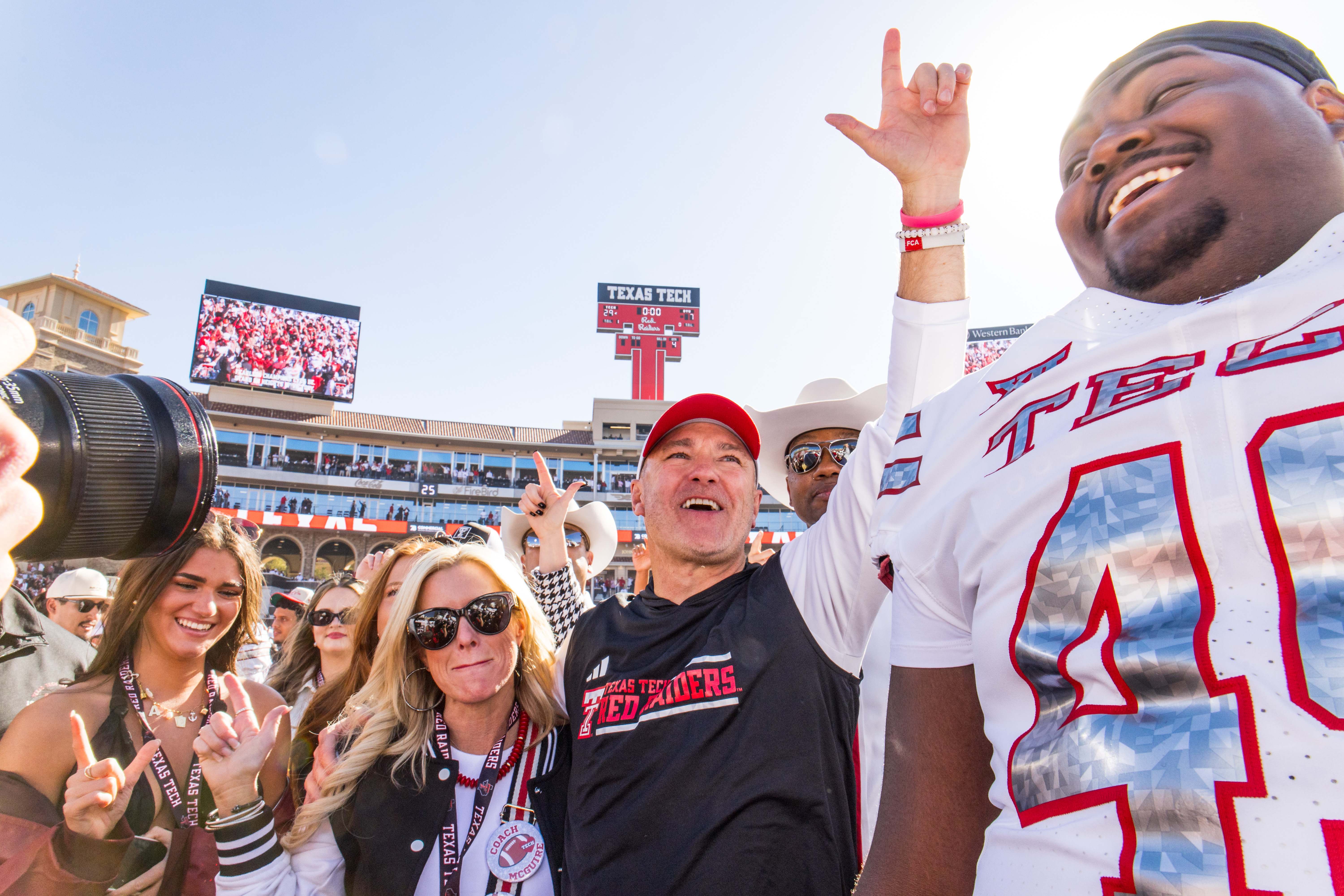
It’s true that none of this would have been possible without Campbell, a 44-year-old former Texas Tech player who hit it big in the oil and gas industry and helped build an infrastructure to ensure the Red Raiders could compete financially at the very top of the sport.
For as long as college sports have been around, the shadowy booster bankrolling a program — whether it was legal or not — has been the source of endless fascination and lore. Campbell’s willingness to talk so openly about the financial aspect, and his dalliances on the political side of college sports, have made him a target for attention to the point where he’s practically the face of the program.
That’s not surprising. But it’s also a little unfair because it’s come at the expense of Joey McGuire getting much credit for just how dominant the Red Raiders were this year.
In fact, he didn’t even get voted Coach of the Year in his own conference, an honor that went to BYU’s Kalani Sitake — who lost to Texas Tech twice.
“I totally understood,” McGuire said. “Kalani did a great job. He’s a freaking rockstar. I wasn’t disappointed.”
But assuming that Texas Tech was always destined to have a season like this regardless of the coach betrays the reality McGuire was dealing with back in August. After going 23-16 in his first three years — not bad compared to the history of Texas Tech, but certainly nothing special — McGuire was under a remarkable amount of pressure to deliver a Big 12 title and a CFP berth.
Given what Texas Tech had invested in this roster, there were no guarantees about his long-term coaching future if things went sideways.
“I’m my own worst critic,” he said. “I think if you’re self-driven, the outside expectations aren’t going to bother you. Anytime, at any level you’re at, whenever you start winning the expectation goes up.”
Talent wasn’t going to be an issue. But after bringing in 21 transfers and spending millions on some of the top players in the portal like edge rusher David Bailey (Stanford) and linebacker Romello Height (Georgia Tech), the question was whether Texas Tech would be able to navigate some of the trickier issues like chemistry, role definition or locker room drama that can impact a roster glued together largely by money.
“It’s a tremendous undertaking, getting a first-year defensive staff on the same page and tying it in with our players,” defensive coordinator Shiel Wood said. “I think it starts with the leadership of Joey McGuire. It’s an extremely positive environment to walk into every day. He does a tremendous job of being the same individual, a consistent leader that guys know what to expect. They know what they’re getting from him and he really creates an environment that’s fun to work in every day.”
Texas Tech didn’t just take all of its talented new players and win games, it mostly dominated them. Outside of one hiccup — a 26-22 loss at Arizona State when quarterback Behren Morton was injured — Texas Tech did not play a single close game in the Big 12.
You can’t do that on talent alone in a power conference.
“The buy-in process has been insane,” Garret McGuire said. “This might be one of the first times in the long history of Red Raider football going into a season you’ve had this much pressure. This is probably what some of those blue-blood programs feel every year. I think we earned that and our play has backed it up so far.”
Stripped down to its simplest form, the Red Raiders represent the idea of new money in a sport that often doesn’t know how to act when the establishment gets disrupted. Oregon, the team Texas Tech will play Thursday, faced that same kind of backlash when its program began growing into national power status thanks to the investment of Nike founder Phil Knight.
Now, the Ducks have been around for so long, they’re just accepted as part of the elite.
Maybe Texas Tech will make the CFP enough times to eventually get the same treatment. But McGuire shouldn’t have to wait that long to get the credit he deserves.
Category: General Sports


