
No matter what happens on Monday in the national title game against Indiana, Miami’s native son Mario Cristobal has accomplished something. He’s restored respect to The U.
CORAL GABLES, Fla. — Above his office desk, Mario Cristobal keeps a reminder of the past.
Hanging on the wall are framed photos of the four football coaches who won a national championship at the University of Miami.
Every day, when Cristobal enters the office before the sun rises and leaves well after it sets, the four faces — Howard Schnellenberger, Jimmy Johnson, Dennis Erickson and Larry Coker — are there to remind him that it can be done here, even though it’s been 24 years.
He needs no more reminders.
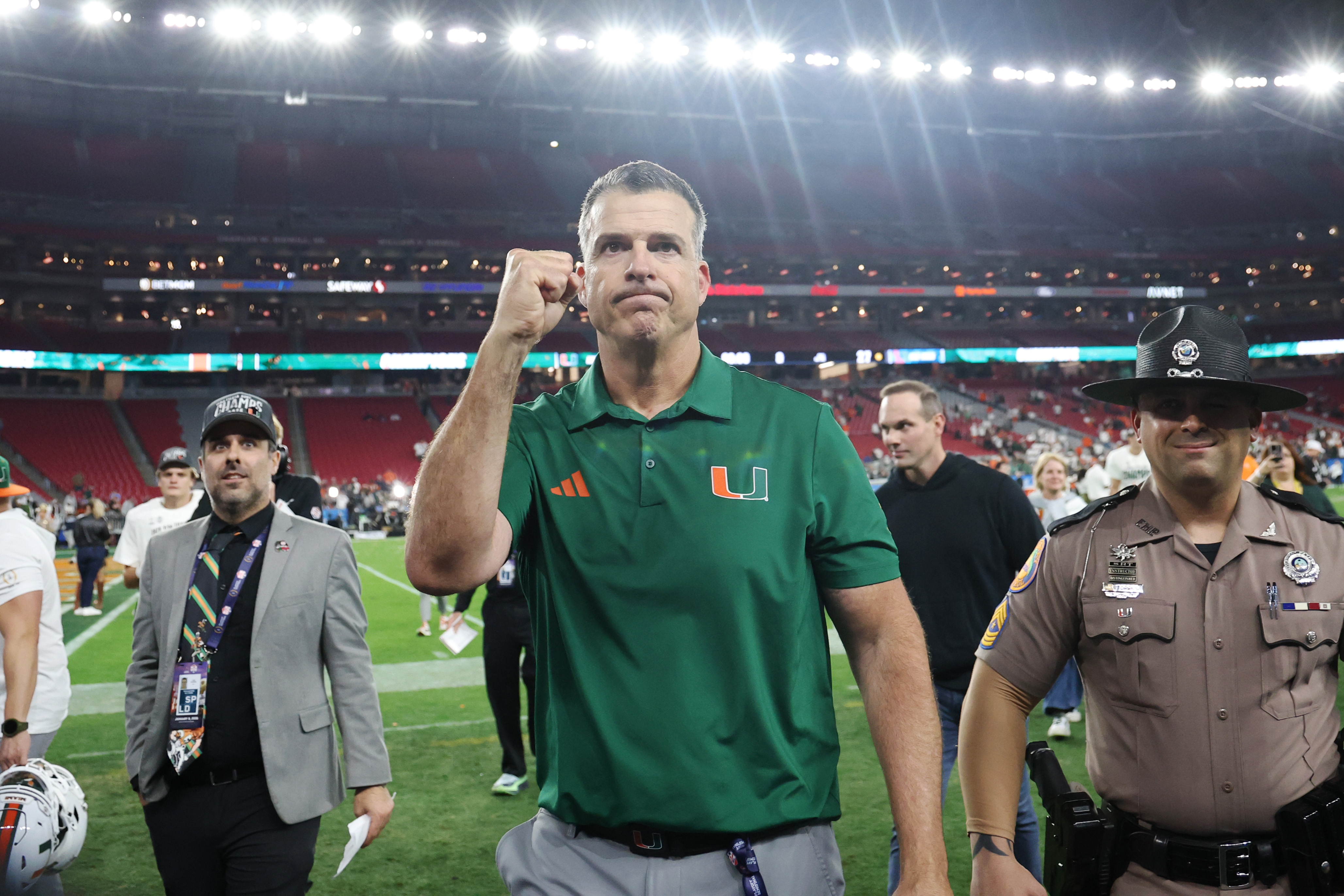
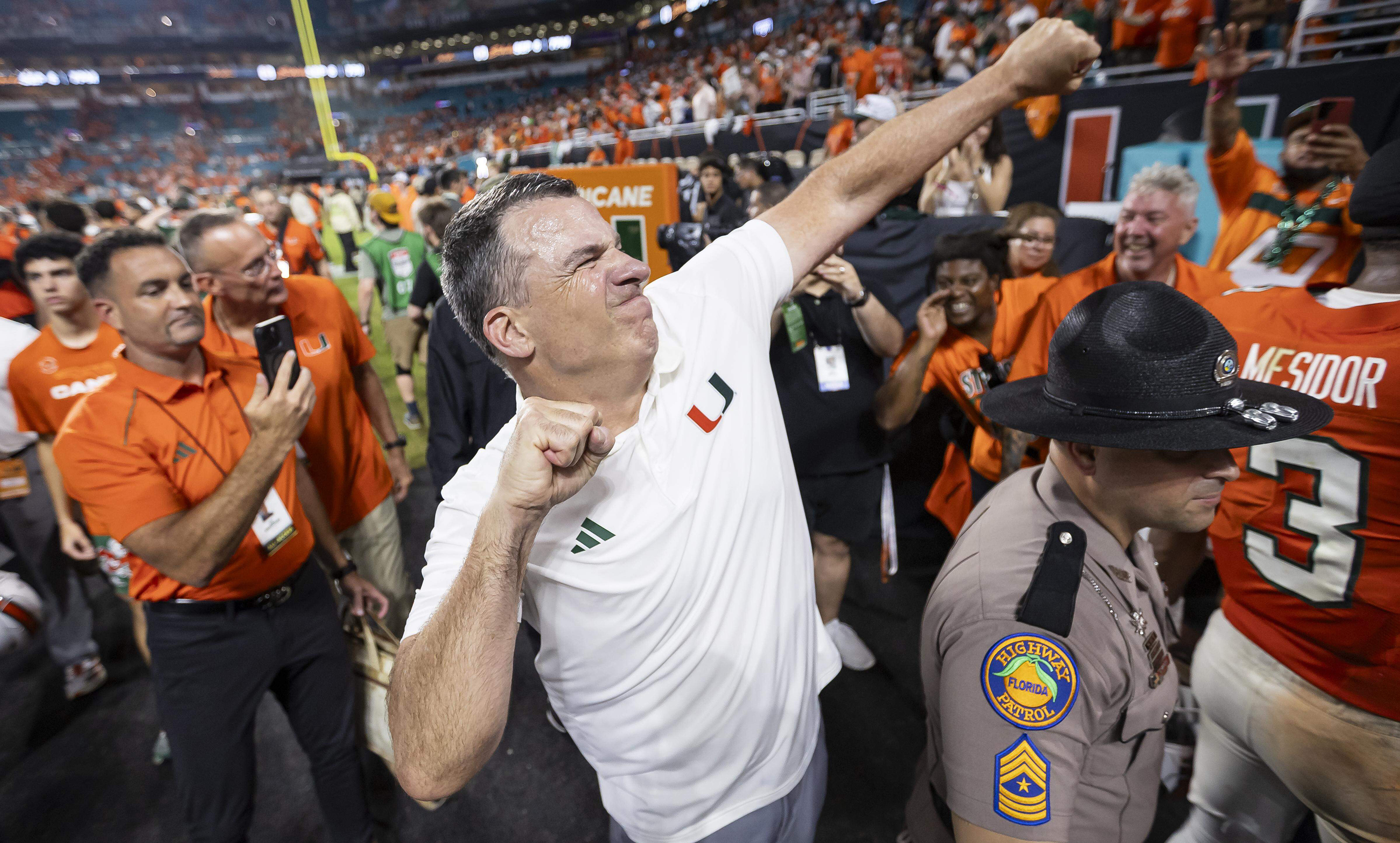
Four years after leaving the powerhouse program he built at Oregon, Cristobal is one win away from returning championship glory to this place, four quarters from delivering his hometown and alma mater the title.
But no matter what happens here Monday — in the national championship bout against Indiana in, of all places, the home of the Hurricanes, Hard Rock Stadium — Miami’s native son, Mario Cristobal, has accomplished something.
He’s restored respect to The U.
“I’ve had 20 years of sitting from afar watching Miami get ridiculed and stomped on. It pissed me off,” Cristobal said this week. “I got to the f***ing point where I couldn’t stand the s*** going on here and the amount of s*** being thrown at it. My brother told me, ‘If you don’t f***ing do it, who the f*** is going to do it?!’”
Lou Cristobal knew brother Mario could do it and would do it. In fact, four years ago, a few months after Miami hired Mario, Lou quipped to a reporter, “I think it’s a given: He’s going to win a national title.”
Earlier this week, Lou chuckles about his prediction.
“I told you so,” he said.
The job, of course, is far from finished, Lou says. The Big Ten champion stands in the way. The Hoosiers are unbeaten, the top-ranked seed in the playoff and are more than 8-point favorites in Miami’s own stadium.
There is an audible shrug from folks here. The ’Canes, after all, historically swim in a limitless confidence.
But in this case, the Cristobals have been underdogs for decades — sons of Cuban immigrants, Luis and Clara, who fled Fidel Castro’s communist regime in the 1960s, not long after Luis was incarcerated as a political prisoner on the island. They met in Miami and spoke only Spanish, the first language of their sons as well.
More than 50 years later, the family’s most famous man leading the hometown Hurricanes to the national championship game in his very own hometown seems like the stuff of fairy tales and fiction novels.
This is why Mario returned to the place he left for so long. He views the last 25-year coaching journey as a plotted course back home: the assistant gig at Rutgers; his time back here as offensive line coach under Coker; the six-year head coaching stint at FIU, which ended in an unceremonious firing (he still keeps his termination letter in his desk as a motivational reminder); and then a coaching rehabilitation stay with Nick Saban at Alabama before the run at Oregon.
It was all for this.
“I owe Miami everything. The University of Miami changed the trajectory of me and my brother and our lives,” he said Tuesday between meetings. “I was ill from afar with people throwing dirt on Miami, making fun of Miami. It was in a really bad spot. It’s a rebuild.
“If I don’t do it, who the hell is going to do it. It had been 20 years. Who is going to do what it takes and endure all the crap and bulls*** and difficult times. I owe Miami. It’s in my blood.”
‘All Roads Lead Home’
How he did it is too long and winding to explain in detail.
But the three most important points are clear: an extreme work ethic (he mostly works 16-18-hour days with plenty of cafecito — a Cuban coffee favorite that he and his brother consumed as children and now as adults); aggressive recruiting (he loves landing prospects just as much as winning games, evident by the three top-10 classes in the last four years); a university-wide commitment to athletic resources (millions from donors plus a university subsidy of more than 40% of the athletic department budget, some of it generated by the school’s health system, UHealth).
All of these ingredients have produced a cocktail of success — a four-year run from Cristobal that saw annual improvements in victories: five in 2022, seven in 2023, 10 in 2024 and 13 so far this season.
“We are one year ahead of schedule,” says Miami president Joe Echevarria, who helped resuscitate the school’s failing health system in 2020, then assisted in landing Cristobal as coach a year later and developed with him a plan for the Hurricanes to compete for the national championship by Year 5.
The coincidental site of the game — Hard Rock Stadium won the championship game bid years ago — is the frothy goodness atop this Cuban espresso of a season. It’s a money-saver too, says athletic director Dan Radakovich. Chartering a football team, staff and families averages about $800,000 a trip.
Across this city, digital advertisements gesture to the hometown Hurricanes. “All Roads Lead Home,” says one.
This is a moneymaker of historic proportions for the university.
Miami is the first true beneficiary of the ACC’s new uneven distribution structure awarding millions to those earning higher television viewership numbers and permitting a single school to retain all of its playoff distribution earned through winning postseason games (in this case, more than $20 million). The revenue change in the ACC — spurred by lawsuits from Florida State and Clemson and spearheaded by commissioner Jim Phillips — charts a roadmap to future revenue frameworks in other leagues, perhaps.
The “drumbeat” of uneven distribution is decades old in some places, Phillips says.
“The strategy is, if you want a higher distribution from the conference, then you need to go invest and improve your chances of having that success,” Phillips told Yahoo Sports.
The ACC hasn’t had a team participate in the national championship game since the 2019 season. After a tumultuous few years — the litigation off the field and struggles on it — the league is back in the big game.
“There was so much noise in the air — the demise of the ACC and that it was headed to a similar destination of the Pac-12,” Phillips said. “To me, it wasn’t fair.”
The championship game boon for Miami goes beyond conference financial dollars.
The school has seen “a lot more people” than last year at this time recommit to season tickets, Radakovich says, and he hopes that this season’s success finally results in the construction of a seven-story football operations center announced in 2022. The school hasn’t yet broken ground.
“That’s what we really need,” he said from his office Friday. “Is now the time to do it? If you believe there’s going to be some intervention by Congress or collective bargaining, then there’s going to be some equaling out of the revenue expenses for [athlete] compensation. If that evens out, [recruiting] goes back to what we had before: How is your stadium and who is your coach and what’s the day to day like? Those will become important again.”
The ‘tipping point’
When Mario Cristobal arrived back here in December of 2021, Miami felt like a shell of the institution for which he played in the early 1990s. The school had fallen behind in resourcing and facilities to the point that even former coach and UM quarterback Mark Richt acknowledged the failures in an interview years ago.
After winning five national championships in a 28-year period, school officials got complacent.
“After all the success, they’re like, ‘Why build something new? We’re already winning without it,’” Richt said.
In fact, in September of 2021 — roughly three months before the hiring of Cristobal — an unlikely person sparked change within Miami. During a segment on ESPN’s “College GameDay,” analyst Kirk Herbstreit delivered a passionate plea urging the school to get serious about its investment in football. The 70-second clip went so viral that the university’s most powerful people were embarrassed and, very quickly, sprung into action.
Herbstreit provided a “tipping point,” says Rudy Fernandez, the executive vice president of UM and senior advisor to the president who the UM board put in charge of the football overhaul.
The school replaced athletic director Blake James and coach Manny Diaz with a pair of high-profile hires: Radakovich, one of the architects of Clemson’s football dynasty, and Cristobal, luring each to Miami with hefty salary pools. The tandem hire, made within days of one another, sent a message across college football: Suddenly, Miami was trying to get back.
“I wasn’t trying to get Blake fired or Manny fired,” Herbstreit said in 2022. “I was really talking more to the people who spend money and where the money needs to go.”
But it was true, says Jose Mas, a prominent Miami booster whose company, MasTec, is worth more than $7 billion. The school “accepted mediocrity,” Mas said.
On the ground, once hired, Cristobal and staff needed to “create belief” again in The U after two decades of doldrums. Miami won 10 games or more in 14 seasons from 1983 to 2003. In the next 20 seasons, UM did that once.
“Miami was Tier 1 when recruits visited when I played here,” he said. “When I came back, it was Tier 3.”
He needed the right people in place, both staff and players. In his fourth season as coach, Cristobal is on his second offensive coordinator and third defensive coordinator. One person close to Cristobal describes him as part Nick Saban, part Ed Orgeron and part Scarface. Many in the coaching fraternity say he’s difficult to work for. But that just means those people aren’t working hard enough, those close to him say.
“A rebuild comes with very difficult steps that you cannot skip. You’re going to have to endure,” Cristobal said. “The things that get in the way of progress are people. Sometimes it’s the very own people in the building. You got to find dudes who want to work to the level that is insane.”
He works so much, in fact, that brother Lou grows concerned that Mario isn’t sleeping enough. Lou and a group of Mario’s closest friends hold a running joke about the coach.
“He’s the only guy who will give you a call just to tell you that he’s got to call you back later,” Lou says with a laugh. “He’s always running.”
Four years after assuming control of the program, Mario, a former offensive lineman, has a team in his likeness. They are physically imposing. They batter and bruise. And just when an opponent focuses on stopping the battering rams of running backs Mark Fletcher Jr. and CharMar Brown, quarterback Carson Beck — with his own redemption tale — stretches the field with star freshman Malachi Toney, Keelan Marion and CJ Daniels.
Two months ago, this team of highly paid standouts sat at 6-2, mostly counted out in the playoff race. But Mario preached persistence. The season is a marathon, he reminded players — not a sprint.
“There’s days where you are running a mile and don’t feel good and your pace is off,” said Dennis Smith, the team’s executive director and frontman in recruiting. “Football is an example of an embodiment of running a marathon. We didn’t get recruits. We lost games. We kept running the marathon.
“We were 6-2. We had a bunch of players who transferred from places where they didn’t have a great year. People were like, ‘Why is that guy coming here?’ When we were 6-2, we didn’t point fingers. We closed ranks and we realized it’s a marathon. Here we are, seven games later, seven tough wins in different ways. That starts with our head coach.”
‘I broke’
During his first three months as head coach at Miami, Mario Cristobal spent late nights and early mornings with his mother at Kindred Hospital, a long-term care center located a few miles from UM’s campus.
He’d show up before or after his time at the office. He’d hold her hand, kiss her forehead, talk to her and share stories, even though she couldn’t understand much or respond.
A couple weeks before he accepted the Miami job, doctors performed an emergency intubation on Clara Cristobal while Mario led Oregon in a practice. He never got to say goodbye.
It sticks with him still today.
“It was devastating,” he says.
He flew to Miami not long afterward, walked into her hospital room and fell to his knees.
“I had never broken,” Mario said. “For a few minutes, I broke. I never imagined seeing my mom in that state. She can’t recognize or talk or barely see.”
Rumors and reports swirled that Mario flew to Miami not to only be with his mother, but to also interview for the Canes job — before Oregon played in the Pac-12 championship game against Utah the next week, an eventual 38-10 Ducks loss.
“I could give a rat’s ass what people think,” Mario said. “I live my life in a manner to do right by people, but people say I used the opportunity to come down here and interview with Miami. Are you f***ing kidding me?”
Clara Cristobal, an 81-year-old suffering from emphysema, kidney disease and septic issues, died on March 4, 2021. At the very end, Mario says Clara began blowing kisses to family members.
“She did know it,” Lou said. “I feel in my heart and mind that she knew Mario was coach at Miami. Her and my dad are watching him now and they’re dancing up in heaven.”
Asked what his mother might say now, Mario shouts aloud, “Win the f***ing game!”
On Monday, from Hard Rock Stadium, the Miami Hurricanes go for national title No. 6.
According to GameTime, the game is the most expensive national championship bout on record with an average ticket price of more than $5,500. As of Friday, the cheapest tickets were close to $4,000.
“It’s the toughest ticket in freaking town right now,” Lou says. “I’ve had cousins reach out who I don’t even know.”
With one final victory, a last step, Mario Cristobal can finally fully resurrect Canes football — even if he’s already delivered respect back to this place.
But whatever you do, don’t tell Mario, “The U is back.”
“That’s what you heard for years. ‘The U is back,’” he says. “I cringe. There is no going back.”
The New U is here.
Category: General Sports


