
The Pistons have their foundation in place — and the ammo to address any holes on their roster.
Two years ago today, the Detroit Pistons were 4-37 and stumbling out of an NBA record 28-game losing streak. The Pistons were the league’s punchline, a team that would scrape together just 10 more wins before the nightmare finally ended. Now, they’re 30-10 and staring down at the rest of the Eastern Conference.
But the climb is only starting. The next few weeks before the Feb. 5 trade deadline will reveal what Detroit still needs to jump from a great story to an unquestionable favorite. Because when April turns into a possession-by-possession fight, everything starts with who can create offense against a set defense.
The hardest piece is already in place. The first thing a team needs to contend is a superstar, and Cade Cunningham has officially leveled up into a genuine All-NBA engine. He’s manipulating defenses with patience, ranking near the top of the league in assists while maintaining three-level scoring and versatile defense.
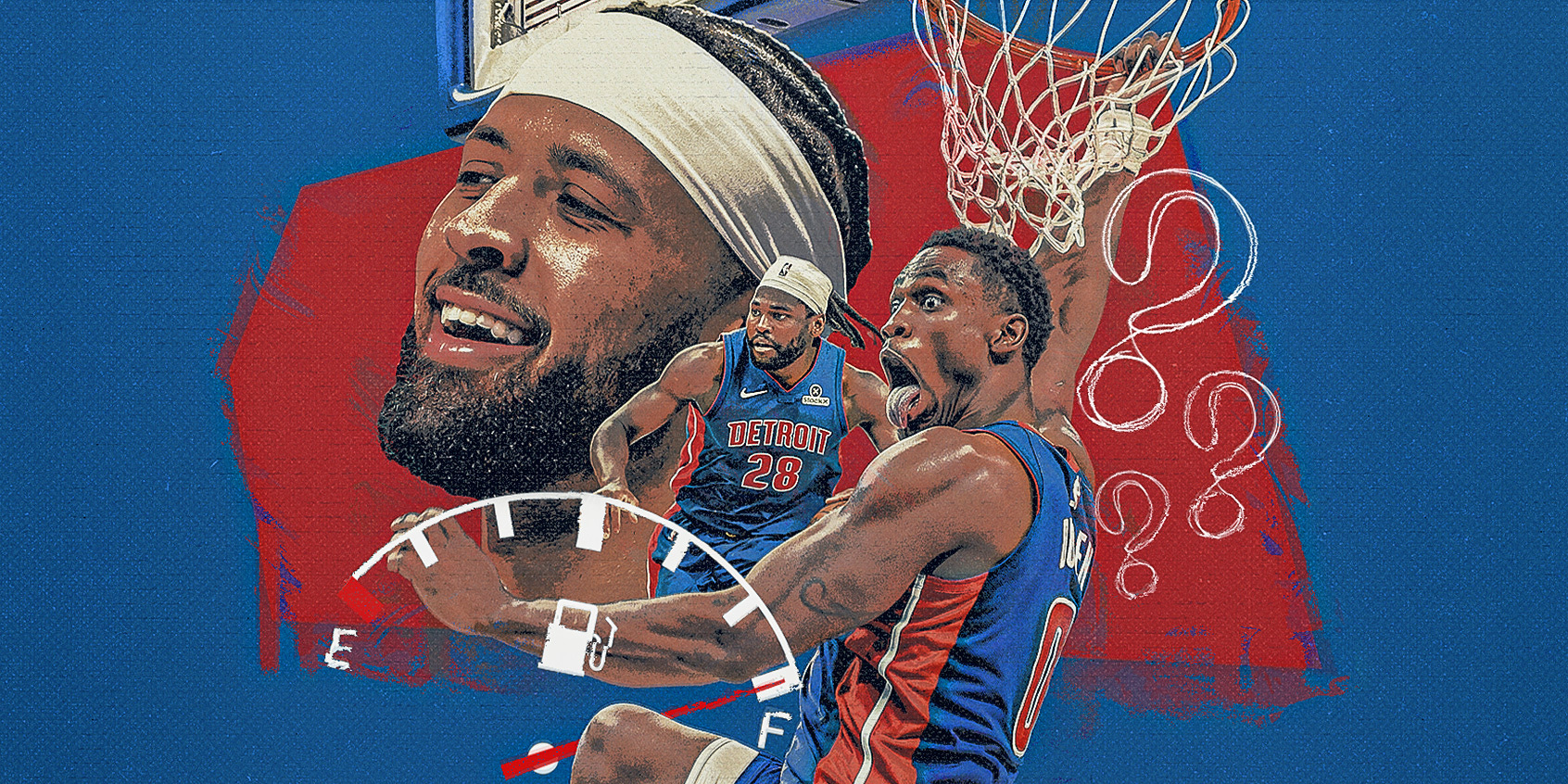
Stars aren’t enough in the modern NBA though. Recent champions and runners-up have been defined by depth. Between smart additions and developmental leaps, Detroit’s supporting cast is strong. Some of it is external. Duncan Robinson’s movement gravity has added a new wrinkle to the offense, while Caris LeVert has provided secondary creation off the bench. But like Cade’s leap, Detroit’s rise is really built on internal growth.
Jalen Duren belongs in the East All-Star conversation for his violent rim pressure, elite rebounding, and back-line defense. He used to drift in and out of games. Now he looks like the spine of an elite unit.
That shift has unlocked a second one. Last season, J.B. Bickerstaff barely played Duren next to another big. Duren and Isaiah Stewart shared the floor for only eight minutes. This season, about 25% of Duren’s minutes have come alongside Stewart. And it’s working because Stewart is also playing the best basketball of his life.
[Subscribe to Yahoo Sports NBA on YouTube]
Stewart still has a reputation as the “tough guy,” and while that is true, he’s not just a classic interior bruiser. Over the last three seasons he’s a 37% 3-point shooter, which changes Detroit’s geometry when he can space to the line and punish any defender inside. But Stewart’s real gift is on defense.
Among 107 players who have defended at least 80 isolations this season, Stewart ranks best, allowing only 0.68 points per isolation. That’s one of the most dominant marks in recent years. The Pistons have comfortably let Stewart switch screens onto the likes of Donovan Mitchell and Kevin Durant, and he has the agility to stay connected without bleeding downhill drives.
If just one of Duren or Stewart is on the floor, the Pistons still have great rim protection thanks to their respective shot-blocking prowess. That lineup flexibility is a big reason the Pistons are second in NBA defensive rating, trailing only the Oklahoma City Thunder.
Bench players like Alex Caruso and Aaron Wiggins had big scoring performances in OKC’s run last year, which serves as another example of why true contenders also need players who can light a spark.
For Detroit, you’d think it would be Jaden Ivey, Ron Holland, or Ausar Thompson, one of Detroit’s former lottery picks. And while each of them has carved out a role, the biggest jolt has often come from Daniss Jenkins, a 24-year-old guard on his second two-way contract after going undrafted in 2024. He’s already had a few “Jenkinsanity” bursts, recently erupting for a 20-point quarter and dishing out a career-high 15 assists. That fearless creation keeps Detroit’s offense from cratering when the starters catch a breather.
The Pistons certainly check a lot of boxes. And a great start makes fans happy, but it also creates a responsibility for the front office to figure out what breaks in the playoffs before the playoffs break it for you. When teams send two at Cade, is it because Thompson or Holland still can’t consistently make them pay as a spacer? If the ball is forced out of Cade’s hands, can Ivey or Tobias Harris be relied on to make a play? And does this roster have enough shooting to win playoff math? Detroit is 27th in 3-point attempts and 18th in 3-point percentage. That profile can survive in January. But maybe not in April.
[Get more Pistons news: Detroit team feed]
All of which brings us to the deadline. The Pistons have the ammo to address any holes. They control a full stash of future firsts, which means they can put four firsts plus three swaps on the table. They also have young players with value (Thompson, Ivey, Holland, Chaz Lanier, Marcus Sasser, and Bobi Klintman). And they have clean salary tools to make any deal work: Ivey is a $10.1 million upcoming restricted free agent, Harris is on a $26.6 million expiring contract, and LeVert will make just over $14 million for one additional season. Between them, other smaller salaries, and their assets, the Pistons can target just about any player.
Here are eight calls Detroit should make, ranked by impact and fit first, and availability second.
1. Trey Murphy, Pelicans forward: Murphy is the cleanest fit for Detroit. He slides into the ecosystem without changing anyone’s shot diet, and his shooting and length raise both the floor and ceiling. At age 25, he also matches Cade’s timeline. The price would be steep (multiple firsts plus youth), but that’s what true two-way wings cost.
2. Michael Porter Jr., Nets forward: MPJ is the more extreme version of the same idea. He is not the same defender as Murphy, but he is a more lethal shooter. Put a 6-foot-10 shotmaker next to Cade, Robinson, and Stewart, and defenses start running out of coverages. The Nets would expect a large return for MPJ.
3. Jaren Jackson Jr., Grizzlies power forward: JJJ is the swing-for-the-fences option. He gives Detroit a third defensive superpower plus a big who can space and close playoff games. Memphis isn’t eager to move him, but given the uncertain state of the team, Detroit should make the call.
4. Naz Reid, Timberwolves big: The Wolves aren’t trying to trade Reid. But in theory, he’s the salary that’d have to move if Minnesota makes a big acquisition. And the Pistons previously expressed interest in signing him during his free agency just last summer, so maybe he could find his way to Detroit in some type of three-way deal. With his shot creation, shooting, and contagious energy, he’d be a perfect third big in Detroit’s frontcourt.
5. Ayo Dosunmu, Bulls guard: Dosunmu has turned into a real shooter, he can slash into space, and he competes defensively. The Bulls are going nowhere and Dosunmu can be a free agent this summer, so perhaps they’d be willing to cash in.
6. Nickeil Alexander-Walker, Hawks wing: NAW is making 42.1% of his catch-and-shoot 3s this season and he can do work off the dribble while also providing versatile defense. There's no reason for the Hawks to move him, especially since he's on such a team-friendly contract of four years, $60.6 million. But the Hawks seem stuck, and maybe they’d listen if the Pistons are willing to overpay.
7. Klay Thompson, Mavericks wing: Klay is quietly having a bounce-back year in less-than-ideal circumstances in Dallas. He still bends defenses with instant-trigger shooting and elite relocation. At $16.7 million this season, he is also the kind of salary you can realistically absorb without detonating the rotation.
8. Jerami Grant, Blazers wing: Welcome back! Grant was traded to the Blazers in 2022 following a career year with the Pistons, and he’s still a good player today. He’s a clean fit who can guard wings, hit spot-ups, and punish closeouts as a third option without stealing too many touches from Cade.
Pistons fans who were around for the 2004 championship will remember the Rasheed Wallace acquisition. The Pistons were already a Finals hopeful at 34-22 and third in the East on the morning of the deadline. Chauncey Billups and Rip Hamilton were an exciting backcourt, Tayshaun Prince was having a breakout season on the wing, and Ben Wallace was in the middle of his second consecutive Defensive Player of the Year run. The Pistons were contenders. But the front office recognized that “good enough” wasn’t going to cut it.
So Detroit targeted Wallace just 10 days after he was already traded to Atlanta, and acquired him for a rotation player and multiple firsts. Wallace came with his warts with a league record technical foul history and a fiery personality that risked disrupting chemistry. And it did, but in a great way. The Pistons finished the year 20-6, as Sheed became a perfect on-court complement and the emotional spark plug that transformed Detroit into a championship unit.
Today’s Pistons find themselves in a nearly identical headspace. They have the engine in Cade, the defensive foundation in Duren and Stewart, and a newfound culture of winning under Bickerstaff. But how hard do you push? Detroit knows how quickly windows can open and shut. Two years ago, this was the league’s worst team. Now, the Pistons get to decide whether to act like a title team.
Category: General Sports


